MATHEMATICS FORM 1

Numbers
Mathematics Form 1
 Study Notes
 Discuss
 Bookmarks
We know that when we count we start 1,2 .... . But there are other numbers like 0, negative numbers and decimals. All these types of numbers are categorized in different groups like counting numbers, integers,real numbers, whole numbers and rational and irrational numbers according to their properties. all this have been covered in this chapter
Numbers are represented by symbols called numerals. For example, numeral for the number ten is 10. Numeral for the number hundred is 100 and so on.
The symbols which represent numbers are called digits. For example the number 521 has three (3) digits which are 5, 2 and 1. There are only tendigits which are used to represent any number. These digits are 0, 1, 2, 3, 4, 5, 6, 7, 8, and 9.
The Place Value in each Digit in Base Ten Numeration
Identify the place value in each digit in base ten numeration
When we write a number, for example 521, each digit has a different value called place value. The 1 on the right means 1 ones which can be written as 1 × 1, the next number which is 2 means tens which can be written as 2 × 10 and the last number which is 5 means 5 hundreds which can be written as 5 × 100. Therefore the number 521 was found by adding the numbers 5 × 100 + 2 × 10 + 1× 1 = 521.
Note that when writing numbers in words, if there is zero between numbers we use word ‘and’
Example 1
Write the following numbers in words:
- 7 008
- 99 827 213
- 59 000
Solution
- 7 008 = Seven thousand and eight.
- 99 827 213 = Ninety nine millions eight hundred twenty seven thousand two hundred thirteen.
- 59 000 = Fifty nine thousand.
Example 2
Write the numbers bellow in expanded form.
- 732.
- 1 205.
Solution
- 732 = 7 x 100 + 3 x 10 + 2 x 1
- 1 205 = 1 x 1000 + 2 x 100 + 0 x 10 + 5 x 1
Example 3
Write in numerals for each of the following:
- 9 x 100 + 8 x 10 + 0 x 1
- Nine hundred fifty five thousand and five.
Solution
- 9 x 100 + 8 x 10 + 0 x 1 = 980
- Nine hundred fifty five thousand and five = 955 005.
Example 4
For each of the following numbers write the place value of the digit in brackets.
- 89 705 361 (8)
- 57 341 (7)
Solution
- 8 is in the place value of ten millions.
- 7 is in the place value of thousands.
Numbers in Base Ten Numeration
Read numbers in base ten numeration
Base Ten Numeration is a system of writing numbers using ten symbols i.e. 0, 1, 2, 3, 4, 5, 6, 7, 8 and 9. Base Ten Numeration is also called decimal system of Numeration.
Numbers in Base Ten Numeration up to One Billion
Write numbers in base ten numeration up to one billion
Consider the table below showing place values of numbers up to one Billion.
| Billions | Hundred millions | Ten millions | Millions | Hundred Thousands | Ten Thousands | Thousands | Hundreds | Tens | Ones |
| 1 | |||||||||
| 1 | 0 | ||||||||
| 1 | 0 | 0 | |||||||
| 1 | 0 | 0 | 0 | ||||||
| 1 | 0 | 0 | 0 | 0 | |||||
| 1 | 0 | 0 | 0 | 0 | 0 | ||||
| 1 | 0 | 0 | 0 | 0 | 0 | 0 | |||
| 1 | 0 | 0 | 0 | 0 | 0 | 0 | 0 | ||
| 1 | 0 | 0 | 0 | 0 | 0 | 0 | 0 | 0 | |
| 1 | 0 | 0 | 0 | 0 | 0 | 0 | 0 | 0 | 0 |
If you are given numerals for a number having more than three digits, you have to write it by grouping the digits into groups of three digits from right. For example 7892939 is written as 7 892 939.
When we are writing numbers in words we consider their place values. For example; if we are told to write 725 in words, we first need to know the place value of each digit. Starting from right side 5 is in the place value of ones, 2 is in the place value of tens and seven is in the place value of hundreds. Therefore our numeral will be read as seven hundred twenty five.
Numbers in Daily Life
Apply numbers in daily life
Numbers play an important role in our lives. Almost all the things we do involve numbers and Mathematics. Whether we like it or not, our life revolves in numbers since the day we were born. There are numerous numbers directly or indirectly connected to our lives.
The following are some uses of numbers in our daily life:
- Calling a member of a family or a friend using mobile phone.
- Calculating your daily budget for your food, transportation, and other expenses.
- Cooking, or anything that involves the idea of proportion and percentage.
- Weighing fruits, vegetables, meat, chicken, and others in market.
- Using elevators to go places or floors in the building.
- Looking at the price of discounted items in a shopping mall.
- Looking for the number of people who liked your post on Facebook.
- Switching the channels of your favorite TV shows.
- Telling time you spent on work or school.
- Computing the interest you gained on your business.
Numbers
Mathematics Form 1
We know that when we count we start 1,2 .... . But there are other numbers like 0, negative numbers and decimals. All these types of numbers are categorized in different groups like counting numbers, integers,real numbers, whole numbers and rational and irrational numbers according to their properties. all this have been covered in this chapter
Natural and Whole number tutorial
By Willbald Mvungi-Ilboru Secondary
Natural numbers are counting numbers. Counting always starts with 1 and continues with 2, 3 … (dots means numbers continue with no end). Therefore Natural or counting numbers starts from 1 and continue to infinite (no end).
Natural numbers are denoted by N. natural numbers can be represented on a horizontal line called number line as shown above:

The other group of numbers starts from zero and it is called whole numbers denoted by W.
We can represent whole numbers on a number line as shown above:

The Difference between Natural and Whole Numbers
Distinguish between natural and whole numbers
Natural numbers are either used to count one to one objects or represent the position of an object in a sequence. They start from one and go on to infinity.This is why they are sometimes referred to as counting numbers. The only whole number that cannot be classified as a natural number is 0. Counting numbers can further be classified into perfect numbers, composite numbers, co-prime/ relatively prime numbers, prime numbers, even and odd numbers.
Even ,Odd, and Prime Numbers
Identify even ,odd, and prime numbers
Even, Odd and Prime numbers tutorial
Tutorial Created by Willbald Mvungi-Ilboru Secondary
Even numbers are those numbers which are divisible by 2. In other words we can say that any natural number which can be divided by 2 is an even number. For example 2, 4, 6, 8, 10, 12, … are even numbers since they are divisible by 2.
Odd numbers are those numbers which are not divisible by 2. In other words we can say that any natural number when divided by 2 and remains 1 including 1 are called odd numbers. Example 1, 3, 5, 7, 9, 11, 13, 15, … are called odd numbers.
Prime numbers are those numbers which are divisible by one and itself excluding one or any natural number which is divisible by one and itself except one. For example 2, 3, 5, 7, 11, 13, 17, … are called prime numbers.
Odd and Prime Numbers on Numbers Lines
Show even , odd and prime numbers on number lines
Odd and Prime Numbers
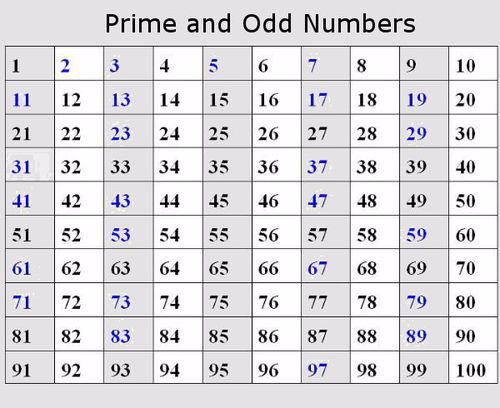
Numbers
Mathematics Form 1
We know that when we count we start 1,2 .... . But there are other numbers like 0, negative numbers and decimals. All these types of numbers are categorized in different groups like counting numbers, integers,real numbers, whole numbers and rational and irrational numbers according to their properties. all this have been covered in this chapter
We have four operations which are: addition (+), subtraction (-), multiplication ( X) and division (÷).
Addition of Whole Numbers
Add whole numbers
When adding numbers we add the corresponding digits in their corresponding place values and we start adding from the right side i.e. from the place value of ones to the next.
We can add numbers horizontally or vertically.
Horizontal addition
Example 5
- 972 + 18=
- 23 750 + 250 =
Solution
- 972 + 18 = 990
- 23 750 + 250 = 24 000
Vertical addition
Example 6

Subtraction of Whole Numbers
Subtract whole numbers
Subtraction is denoted by the sign (-). It is sometimes called minus. Subtraction is the opposite of addition. Subtraction also means reduce a number from certain number and the answer that is obtained is called difference..
Subtraction is done in similar way like addition. We subtract the corresponding digits in their corresponding place value. For example; 505 – 13. We first subtract ones, which are 5 and 3. Subtract3 from 5 gives 2. Followed by tens which are 0 and 1. Subtract 1 from 0 is not possible. In order to make it easy, take 1 from 5 (hundreds). When 1 is added to 0 it has to be changed to be tens since it is added to a place of tens. So, when 1 comes into a place of tens it becomes 10. So add 10 to 0. We get 10. Now, subtract 1 from 10. We get 9. We are left with 4 in a place of hundreds since we took 1. There for our answer will be 492.
Note that similar manner will be used when subtracting.
Example 7

Multiplication of Whole Numbers
Multiply whole numbers
Multiplication means adding repeatedly depending on the times number given. For example; 25 6 means add 25, repeat adding 6 times i.e. 25 + 25 + 25 + 25 +25 + 25 = 150. The answer obtained after multiplying two or more numbers is called product. The number being multiplied is called a multiplicand while the number used in multiplying is called a multiplier. Referring our example, 25 is multiplicand and 6 is multiplier.
Example 8

Division of Whole Numbers
Divide whole numbers
Division is the same as subtraction. You subtract divisor (the number used to divide another number) from dividend (the number which is to be divided), we repeat subtracting divisor to the answer obtained until we get zero. The answer is how many times you repeat subtraction.
For example; 27 ÷9, we take 27 we subtract 9, we get 18. Again we take 18 we subtract 9, we get 9. We take 9 we subtract 9 we get 0. We repeat subtraction three times. Therefore the answer is 3. The answer obtained is called quotient. Referring to our example; 27 is dividend, 9 is divisor and 3 is quotient. If a number can’t be divided exactly, what remains or left over is called a remainder.
Example 9

The Four Operations in Solving Word Problems
Use the four operations in solving word problems
Sometimes you may be given a question with mixed operations +, -, xand ÷ . We do multiplication and division first then addition and subtraction.
Example 10
- 12 ÷ 4 + 3 x 5
- 14 x2 ÷ 7 – 3 + 6
Solution
- 12 x 4 + 3 x 5 =3 + 15 (do division and multiplication fist) =18
- 14 x 2 ÷ 7 – 3 + 6 =28 ÷ 7 - 3 + 6 (multiply first) =4 – 3 + 6 (then divide) =10 – 3 (add then subtract) =7
We may use brackets to separate x,÷ , + and – if they are mixed in the same problem and use what is called BODMAS . BODMAS is the short form of the following:
B for Brackets, O for Open, D for Division. M for Multiplication, A for Addition and S for Subtraction
Therefore, with mixed operations, we first do the operation inside the brackets; we say that we open the brackets. Then we do division followed by multiplication, addition and lastly subtraction.
Example 11

Word problems on whole numbers
Example 12
In a school library there are 6 shelves each with 30 books. How many books are there?
Solution
Each shelf has 30 books
6 shelves have 30 × 6 = 180 books.
Therefore, there are 180 books.
Example 13
Juma’s mother has a garden with Tomatoes, Cabbages and Water Lemons. There are 4 rows of Tomato each with 30 in it. 6 rows of Cabbages with 25 in each and 3 rows of Water Lemo
Solution
There are 30 Tomatoes in each row
4 rows will have 30 × 4 = 120 Tomatoes
Each row has 25 Cabbages
6 rows have 25 × 6 = 150 Cabbages
Each row has 15 Water Lemons
3 rows have 15 × 3 = 45 Water Lemons
In total there 120 + 150 + 45 = 315 plants.
Therefore in Juma’s mother garden there are 315 plants.
Example 14
A school shop collects sh 90 000 from customers each day. If sh 380 000 from the collection of 6 days was used to buy books. How much money was left?
Each day the collection is sh 90 000
6 days collection is sh 90 000 × 6 = sh 540 000
The money left will be = Total collection – Money used
= sh 540 000 – sh 380 000 = sh 160 000
Therefore the money left was sh 160 000
Exercise 1
1. For each of the following numbers write the place value of a digit in a bracket.
- 899 482 (4)
- 1 940 (0)
- 9 123 476
2. Write the numerals for each of the following problems.
- Ten thousand and fifty one.
- Nine hundred thirty millions one hundred twenty five thousand three hundred seventy four.
- 6 x 100 + 1 x 10 + 7 x 1
- 5 x 10 000 + 4 x 1 000 + 2 x 100 + 7 x 10 + 8 x 1
3. Write the following numerals in words
- 952 817
- 98 802 750
4. Write down even, odd and prime numbers between 90 and 100.
5. Compute:
- 25 940 + 72 115 – 5 750 =
- 892 x 12=
- 14 670 ÷ 15 =
6. Calculate: (75 ÷3) + 7 – 14 + (13 x2) =
7. There are 23 streams at Mamboleo primary school. If each stream has 60 pupils except 4 streams which they have 75 pupils each. How many pupils are there at Mamboleo primary school?
8. Hamis uses 200 shillings every day for transport. How much money will he use for 35 days?
Numbers
Mathematics Form 1
We know that when we count we start 1,2 .... . But there are other numbers like 0, negative numbers and decimals. All these types of numbers are categorized in different groups like counting numbers, integers,real numbers, whole numbers and rational and irrational numbers according to their properties. all this have been covered in this chapter
Factors and Multiples tutorial
Tutorial Created by Willbald Mvungi-Ilboru Secondary
Factors of a Number
Find factors of a number
Consider two numbers 5 and 6, when we multiply these numbers i.e. 5 x 6 the answer is 30. The numbers 5 and 6 are called factors or divisors of 30 and number 30 is called a multiple of 5 and 6. Therefore factors are the divisors of a number.
Example 15
Find all factors of 12
Note that, when listing the factors we don’t repeat any of it.

Multiples of a Number
Find multiples of a number
Multiples of a number are the products of a number. For example multiples of 4 are 4, 8, 12, 16, 20, 24, … This means multiply 4 by 1, 2, 3, 4, 5, 6, … .
Example 16
Example
List all multiples of 6 between 30 and 45.
Solution
The multiples of 6 are: 6×1 = 6; 6×2 = 12; 6×3 = 18; 6×4 = 24; 6×5 = 30; 6×6 = 36; 6×7 = 42; 6×8 = 48 and so on.
Therefore, multiples of 6 between 30 and 45 are 36 and 42.
Factors to Find the Greatest Common Factors(GCF) of Numbers
Use factors to find the greatest common factors(GCF) of numbers
G.C.F tutorial
Tutorial Created by Willbald Mvungi-Ilboru Secondary
Greatest Common Factor is sometimes called Highest Common Factor. Its short form is (GCF) or (HCF) respectively. The Greatest Common Factor is the largest common divisor of two or more numbers given.
For example if you are told to find the GCF of 15 and 25. First, list all factors or divisors of 15 and that of 25. Thus, factors of 15 are 1, 3, 5, 15factors of 25 are 1, 5, 25
The common factors are 1 and 5. Therefore the GCF is 5.
Example 17
Example1
Find the HCF of 72 and 120.
Solution
We have to list factors of our numbers:
Factors of 72 are 1, 2, 3, 4, 6, 8, 9, 12, 18, 24, 36, 72
Factors of 120 are 1, 2, 3, 4, 5, 6, 8, 10, 12, 15, 20, 24, 30, 40, 60, 120
The common factors are 1, 2, 3, 4, 6, 8, 12, 24.
Therefore the HCF of 72 and 120 is 24.
Another method which can be used to find the GCF or HCF is prime factorization method.
Example 18
Example
Find the HCF of 36 and 48.
Solution
We have to find prime factors of 36 and 48 first
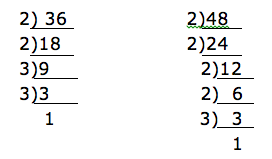
thus, 36 = 2×2×3×3.
48 = 2×2×2× 2×3.
After writing the numbers as a product of their prime factors, take only the common prime factors (prime factors appeared to all numbers). In our example the common factors are 2×2×3. Therefore the HCF of 36 and 48 is 12.
Lowest Common Multiple (LCM)
Lowest Common Multiple is also called Least Common Multiple and its short form is LCM.For example: multiples of 5 are 5, 10, 15, 20, 25, 30, 35, 40, 45, 50, 55, …multiples of 3 are 3, 9, 15, 18, 21, 24, 27, 30, 33, ….
When you look carefully at these multiples of 5 and 3 you notes that 15 had appeared to both. This multiple which appear to both is called a common multiple. If there are more than one common multiples which appeared the smaller common multiple is what is called Lowest Common Multiple.
Example 19
Find the common multiples and then show the Lowest Common Multiple of the numbers 4, 6 and 8.
Solution
Multiples of 4 are 4, 8, 12, 16, 20, 24, 28, 32, 36, 40, 44, 48, 52, 56, …
Multiples of 6 are 6, 12, 18, 24, 30, 36, 42, 48, 54, 60, …
Multiples of 8 are 8, 16, 24, 32, 40, 48, 56, 64, 72, …
The common multiples of 4, 6 and 8 are 24, 48, …
Therefore the Lowest Common Multiple of 4, 6, and 8 is 24.
We can find the Lowest Common Multiple (LCM) of numbers by writing the numbers as a product of their prime factors. The method is called prime factorization.
Example 20
Find the LCM of 24 and 36 by prime factorization method.
Solution
Let us find prime factors of each number by dividing the numbers by their prime factors.
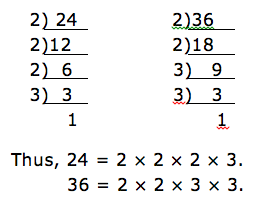
Now take the prime factors which appear to both numbers i.e. 2×2×3 (we take without repeating). We are left with 2 which is a multiple of 24 and 3 which is a multiple 36. We have also to multiply these prime factors left i.e. 2×2×2×3×3. This gives 72. Therefore the LCM of 24 and 36 is 2×2×2×3×3= 72.
Here is a tutorial o n L.C.M
Tutorial Created by Willbald Mvungi-Ilboru Secondary
Numbers
Mathematics Form 1
We know that when we count we start 1,2 .... . But there are other numbers like 0, negative numbers and decimals. All these types of numbers are categorized in different groups like counting numbers, integers,real numbers, whole numbers and rational and irrational numbers according to their properties. all this have been covered in this chapter
Integers
Identify integers
Comparing integers tutorial
Tutorial Created by Willbald Mvungi-Ilboru Secondary
Consider a number line below

The numbers from 0 to the right are called positive numbers and the numbers from 0 to the left with minus (-) sign are called negative numbers. Therefore all numbers with positive (+) or negative (-) sign are called integers and they are denoted by Ζ. Numbers with positive sign are written without showing the positive sign. For example +1, +2, +3, … they are written simply as 1, 2, 3, … . But negative numbers must carry negative sign (-). Therefore integers are all positive and negative numbers including zero (0). Zero is neither positive nor negative number. It is neutral.
The numbers from zero to the right increases their values as the increase. While the numbers from zero to the left decrease their values as they increase. Consider a number line below.

If you take the numbers 2 and 3, 3 is to the right of 2, so 3 is greater than 2. We use the symbol ‘>’ to show that the number is greater than i. e. 3 >2(three is greater than two). And since 2 is to the left of 3, we say that 2 is smaller than 3 i.e. 2<3. The symbol ‘<’ is use to show that the number is less than.
Consider numbers to the left of 0. For example if you take -5 and -3. -5 is to the left of -3, therefore -5 is smaller than -3. -3 is to the right of -5, therefore -3 is greater than -5.
Generally, the number which is to the right of the other number is greater than the number which is to the left of it.
If two numbers are not equal to each to each other, we use the symbol ‘≠’ to show that the two numbers are not equal. The not equal to ‘≠’ is the opposite of is equal to ‘=’.
Example 21
Represent the following integers Ζ on a number line
- 0 is greater than Ζ and Ζ is greater than -4
- -2 is less than Ζ and Ζ is less than or equal to 1.
Solution
a. 0 is greater than Ζ means the integers to the left of zero and Ζ is greater than -4 means integers to the left of -4. These numbers are -1, -2 and -3. Consider number line below

b. -2 is less than Ζ means integers to the right of -2 and Ζ is less than or equal to 1 means integers to the left of 1 including 1. These integers are -1, 0 and 1. Consider the number line below

Example 22
Put the signs ‘is greater than’ (>), ‘is less than’ (<), ‘is equal to’ (=) to make a true statement.
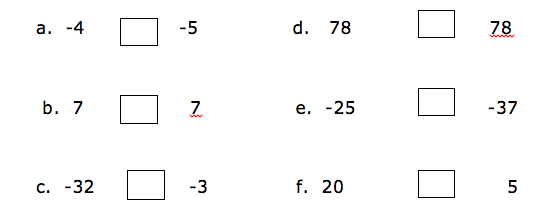
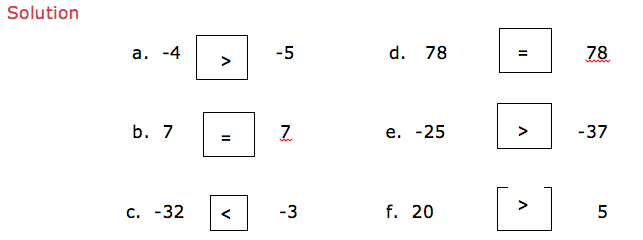
Addition of Integers
Add integers
Example 23
2 + 3
Show a picture of 2 and 3 on a number line.
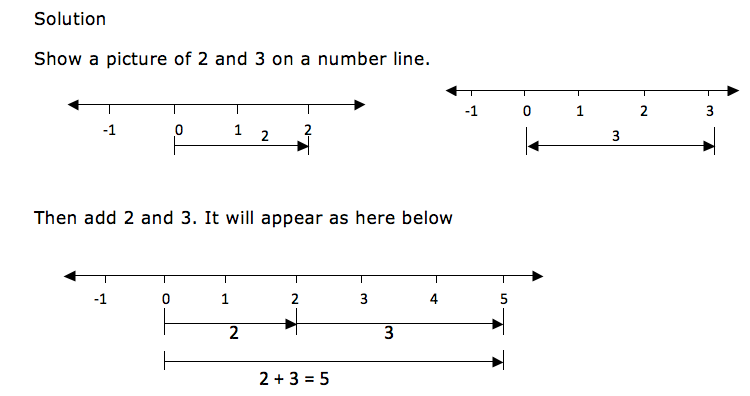
When drawing integers on a number line, the arrows for the positive numbers goes to the right while the arrows for the negative numbers goes to the left. Consider an illustration bellow.
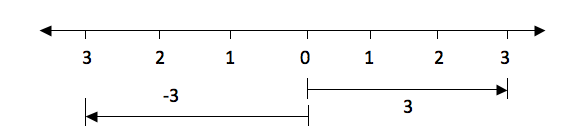
The distance from 0 to 3 is the same as the distance from 0 to -3, only the directions of their arrows differ. The arrow for positive 3 goes to the right while the arrow for the negative 3 goes to the left.
Example 24
-3 + 6
Solution
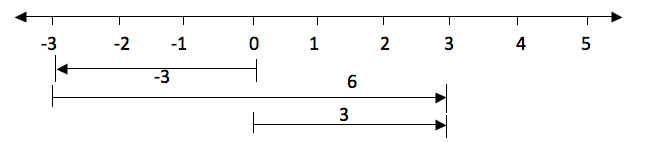
Subtraction of Integers
Subtract integers
Since subtraction is the opposite of addition, if for example you are given 5-4 is the same as 5 + (-4). So if we have to subtract 4 from 5 we can use a number line in the same way as we did in addition. Therefore 5-4 on a number line will be:
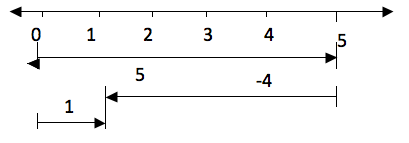
Take five steps from 0 to the right and then four steps to the left from 5. The result is 1.
Multiplication of Integers
Multiply integers
Multiplication of integers tutorial
Tutorial Created by Willbald Mvungi-Ilboru Secondary
Example 25
2×6 is the same as add 2 six times i.e. 2×6 = 2 + 2 + 2 + 2 + 2 +2 = 12. On a number line will be:
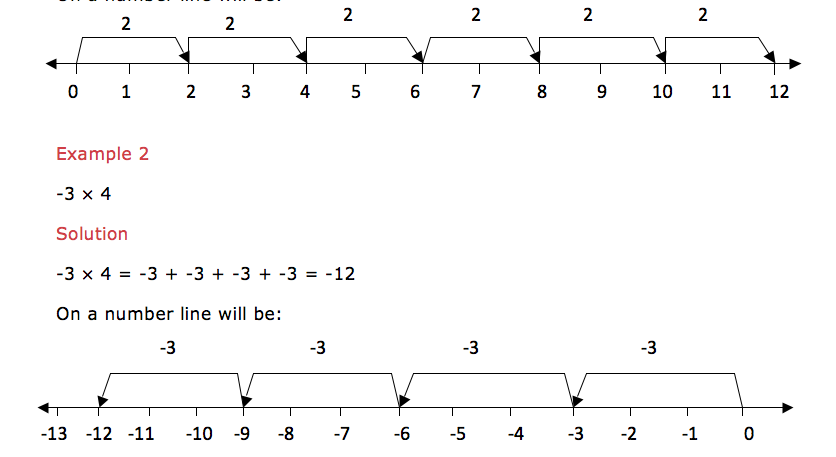
Multiplication of a negative integer by a negative integer cannot be shown on a number line but the product of these two negative integers is a positive integer.
From the above examples we note that multiplication of two positive integers is a positive integer. And multiplication of a positive integer by a negative integer is a negative integer. In summary:
- (+)×,(+) = (+)
- (-)×,(-) = (+)
- (+)×,(-) = (-)
- (-)×,(+) = (-)
Division of Integers
Divide integers
Example 26
6÷3 is the same as saying that, which number when you multiply it by 3 you will get 6, that number is 2, so, 6÷3 = 2.
Therefore division is the opposite of multiplication. From our example 2×3 = 6 and 6÷3 = 2. Thus multiplication and division are opposite to each other.
Dividing two integers which are both positive the quotient (answer) is a positive integer. If they are both negative also the quotient is positive. If one of the integer is positive and the other is negative then the quotient is negative. In summary:
- (+)÷(+) = (+)
- (-)÷(-) = (+)
- (+)÷(-) = (-)
- (-)÷(+) = (-)
Mixed Operations on Integers
Perform mixed operations on integers
You may be given more than one operation on the same problem. Do multiplication and division first and then the rest of the signs. If there are brackets, we first open the brackets and then we do division followed by multiplication, addition and lastly subtraction. In short we call it BODMAS. The same as the one we did on operations on whole numbers.
Example 27
9÷3 + 3×2 -1 =
Solution
9÷3 + 3×2 -1
=3 + 6 -1 (first divide and multiply)
=8 (add and then subtract)
Example 28
(12÷4 -2) + 4 – 7=
Solution
(12÷4 -2) + 4 – 7
=1 + 4 – 7 (do operations inside the brackets and divide first)
=5 – 7 (add)
= -2
Fractions
Mathematics Form 1
A fraction is a number which is expressed in the form of a/b where a - is the top number called numerator and b- is the bottom number called denominator.
A Fraction
Describe a fraction
A fraction is a number which is expressed in the form of a/b where a - is the top number called numerator and b- is the bottom number called denominator.
Consider the diagram below
The shaded part in the diagram above is 1 out of 8, hence mathematically it is written as 1/8

Example 1
(a) 3 out of 5 ( three-fifths) = 3/5
Example 2
(b) 7 0ut of 8 ( i.e seven-eighths) = 7/8
Example 3
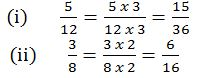
- 5/12=(5 X 3)/(12 x 3) =15/36
- 3/8 =(3 x 2)/(8 X 2) = 6/16
Dividing the numerator and denominator by the same number (This method is used to simplify the fraction)
Difference between Proper, Improper Fractions and Mixed Numbers
Distinguish proper, improper fractions and mixed numbers
Proper fraction -is a fraction in which the numerator is less than denominator
Example 4
Proper fractions; 4/5, 1/2, 11/13
Improper fraction -is a fraction whose numerator is greater than the denominator
Example 5
Example of improper fractions are; 12/7, 4/3, 65/56
Mixed fraction -is a fraction which consist of a whole number and a proper fraction
Example 6
Mixed fractions

(a) To convert mixed fractions into improper fractions, use the formula below
(b) To convert improper fractions into mixed fractions, divide the numerator by the denominator

Example 7
Convert the following mixed numbers into improper fractions

Solution:
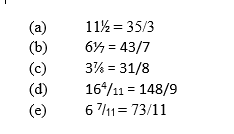
Example 8
Change 7/4 into a mixed number
Solution:
7/4 = 1¾
Example 9
Write the following fractions in order of size beginning with the smallest; 2/3, 5/6, 1/2, 3/4
Solution:
Change the fractions into decimals
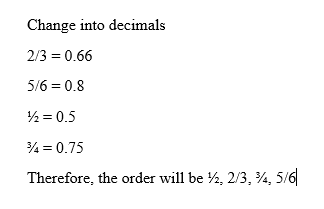
Fractions
Mathematics Form 1
A fraction is a number which is expressed in the form of a/b where a - is the top number called numerator and b- is the bottom number called denominator.
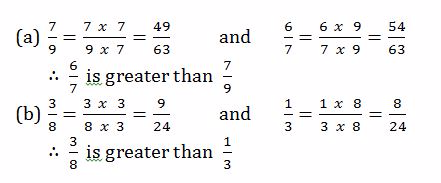
In order to find which fraction is greater than the other, put them over a common denominator, and then the greater fraction is the one with greater numerator.
A Fraction to its Lowest Terms
Simplify a fraction to its lowest terms
Example 10
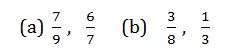
For the pair of fractions below, find which is greater
Solution
Equivalent Fractions
Identify equivalent fractions
Equivalent Fraction
- Are equal fractions written with different denominators
- They are obtained by two methods
Multiplying the numerator and denominator by the same number
Give equivalent fractions to 1/4

.
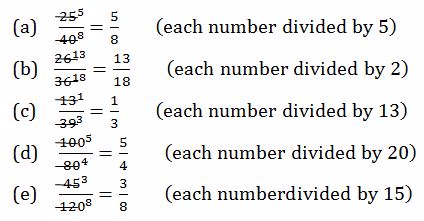
Dividing the numerator and denominator by the same number (this method is used to simplify the fraction)

NOTE: The fraction which cannot be simplified more is said to be in its lowest form
Example 11
Simplify the following fractions to their lowest terms

Solution
Fractions in Order of Size
Arrange fractions in order of size
Example 12
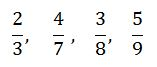
Arrange in order of size, starting with the smallest, the fraction
Solution
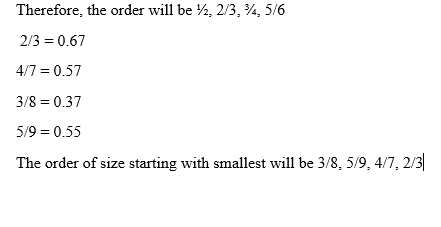
Change the fractions into decimals
Fractions
Mathematics Form 1
A fraction is a number which is expressed in the form of a/b where a - is the top number called numerator and b- is the bottom number called denominator.
Addition of Fractions
Add fractions
Operations on fractions involves addition, subtraction, multiplication and division
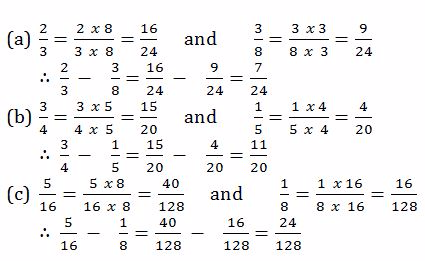
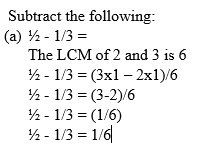
- Addition and subtraction of fractions is done by putting both fractions under the same denominator and then add or subtract
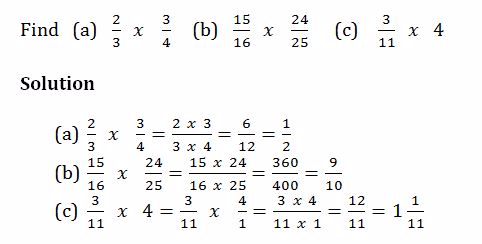
- Multiplication of fractions is done by multiplying the numerator of the first fraction with the numerator of the second fraction, and the denominator of the first fraction with the denominator the second fraction.
- For mixed fractions, convert them first into improper fractions and then multiply
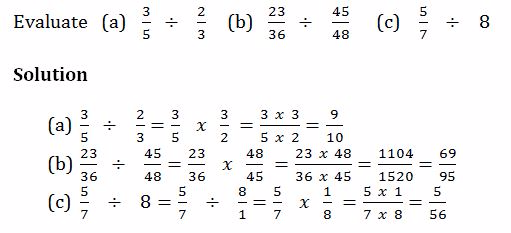
- Division of fractions is done by taking the first fraction and then multiply with the reciprocal of the second fraction
- For mixed fractions, convert them first into improper fractions and then divide
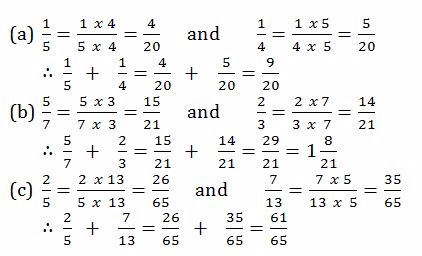
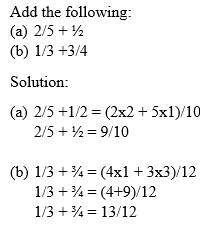
Example 13
Find

Solution
Example 14
Subtraction of Fractions
Subtract fractions
Example 15
Evaluate

Solution
Example 16
Multiplication of Fractions
Multiply fractions
Example 17
Division of Fractions
Divide fractions
Example 18
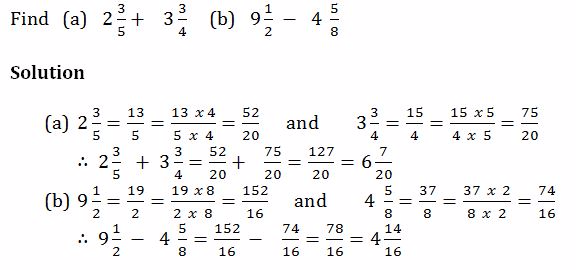
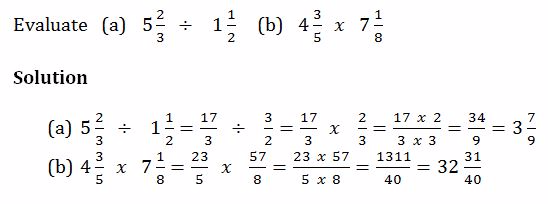
Mixed Operations on Fractions
Perform mixed operations on fractions
Example 19
Example 20
Word Problems Involving Fractions
Solve word problems involving fractions
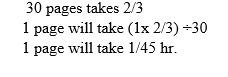
Abdiel takes 2/3 of an hour to read 30 pages of a story book. How long does he take to read 1 page?
Solution:
1 page will take?
Example 21
Musa is 12 years old. His father is 3¾ times as old as he is. How old is his father?
Solution:

Example 22
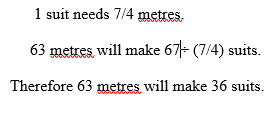
1¾ metres of a material are needed to make a suit. How many suits can be made from 63 metres?
Solution:
The Concept of Decimals
Explain the concept of decimals
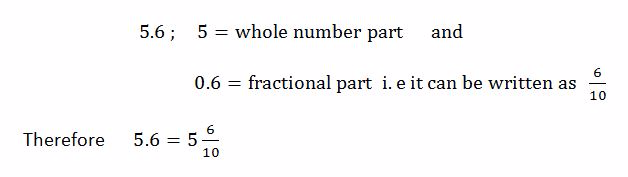
A decimal- is defined as a number which consist of two parts separated by a point.The parts are whole number part and fractional part
Example 1
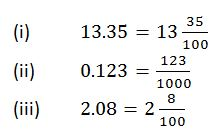
Example 2
Conversion of Fractions to Terminating Decimals and Vice Versa
Convert fractions to terminating decimals and vice versa
The first place after the decimal point is called tenths.The second place after the decimal point is called hundredths e.t.c
Consider the decimal number 8.152

NOTE
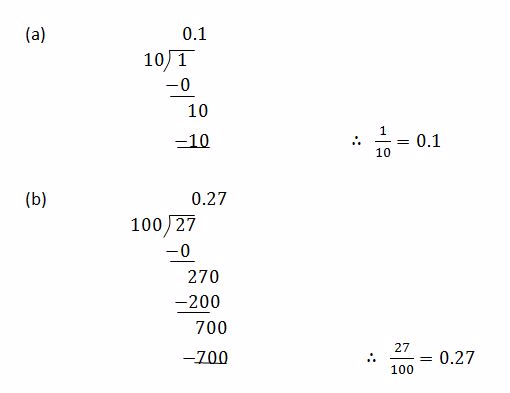
- To convert a fraction into decimal, divide the numerator by denominator
- To convert a decimal into fraction, write the digits after the decimal point as tenths, or hundredths or thousandths depending on the number of decimal places.
Example 3
Convert the following fractions into decimals

Solution
Divide the numerator by denominator
Addition of Decimals
Add decimals
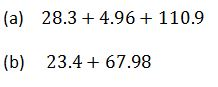
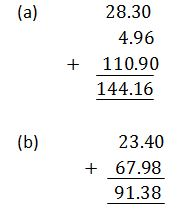
Example 4
Evaluate
Solution
Subtraction of Decimals
Subtract decimals
Example 5
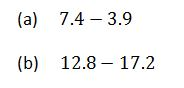
Solution
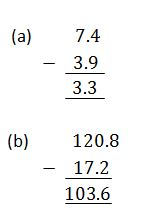
Multiplication of Decimals
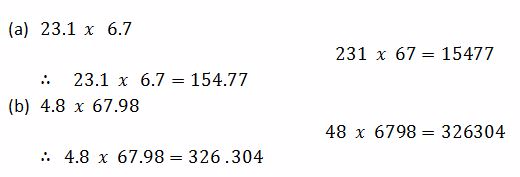
Multiply decimals
Example 6
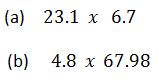
Solution
Mixed Operations with Decimals
Perform mixed operations with decimals
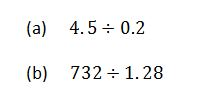
Example 7
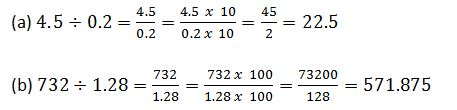
Solution
Word Problems Involving Decimals
Solve word problems involving decimals
Example 8
If 58 out of 100 students in a school are boys, then write a decimal for the part of the school that consists of boys.
Solution
We can write a fraction and a decimal for the part of the school that consists of boys.
| fraction | decimal |
| 58/100 | 0.58 |
Decimal And Percentage
Mathematics Form 1
Expressing a Quantity as a Percentage
Express a quantity as a percentage
The percentage of a quantity is found by converting the percentage to a fraction or decimal and then multiply it by the quantity.
Example 9
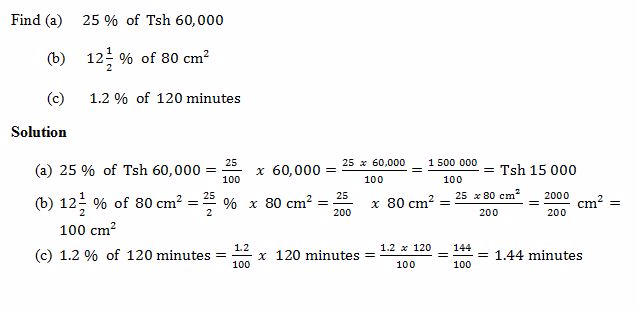
NOTE:The concept of percentage of a quantity can be used to solve the problems involving percentage increase and decrease as shown in the below examples:-
A Fractions into Percentage and Vice Versa
Convert a fraction into percentage and vice versa
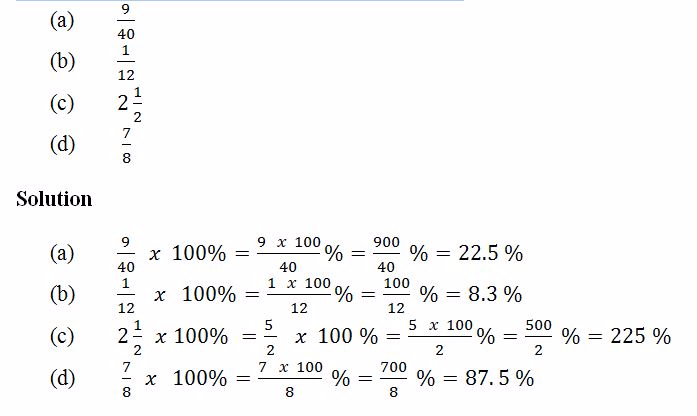
To change a fraction or a decimal into a percentage, multiply it by 100%
Example 10
Convert the following fractions into percentages
A Decimal into Percentage and Vice Versa
Convert a decimal into percentage and vice versa
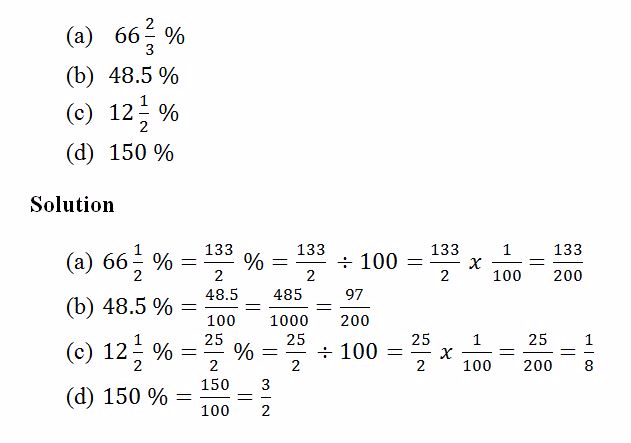
To change a percentage into a fraction or a decimal, divide it by 100%
Example 11
Convert the following percentages into decimals
Percentages in Daily Life
Apply percentages in daily life
Example 12
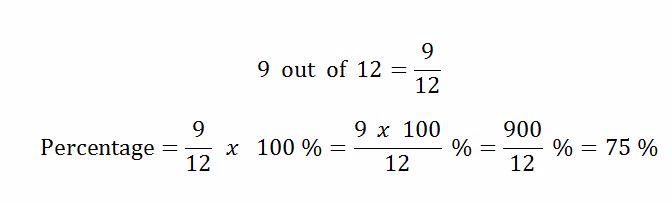
In an assignment, Regina scored 9 marks out of 12. Express this as a percentage
Solution
Example 13
A school has 400 students of which 250 are girls. What percentage of the students are not girls?
Solution

Units
Mathematics Form 1
A unit – is defined as a symbol or sign which is assigned to a number to describe a kind of measurement made
Convertion of One Unit of Length to Another
Convert one unit of length to another
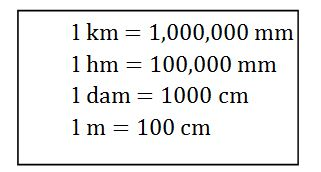
The conversion of one unit to another is done by considering the arrangement below
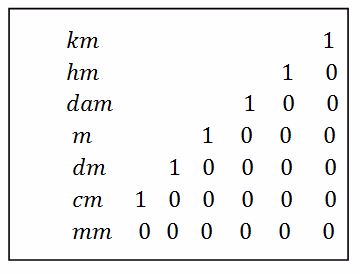
Example, from the above we get
Computations on Metric Units of Length
Perform computations on metric units of length
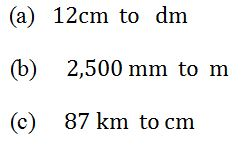
Example 1
Convert
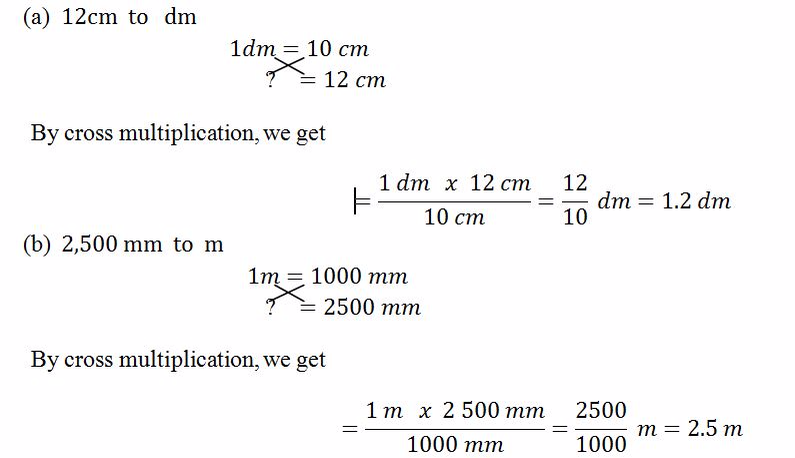
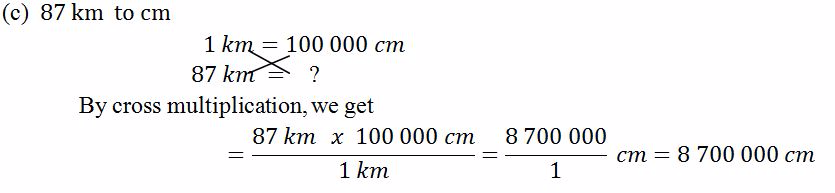
Solution
Example 2
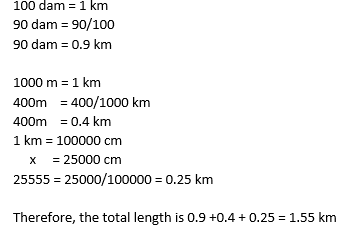
Three pieces of a string measures 90 dam, 400 m and 25000 cm. Find their total length.
Solution:
Units
Mathematics Form 1
A unit – is defined as a symbol or sign which is assigned to a number to describe a kind of measurement made
Convertion of One Unit of Mass to Another
Convert one unit of mass to another
The conversion of one unit to another is done by considering the arrangement below
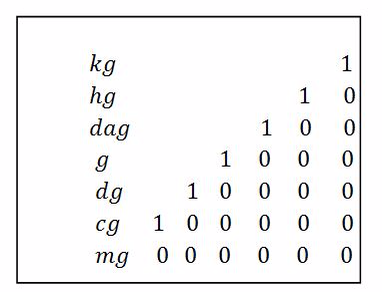
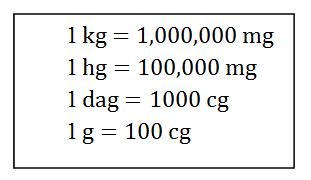
Example, from the above
The conversion of tonneto other units is done converting it to kilogramfirst and then fromkilogramto the required unit.
1 tonne = 1000kg
Computation on Metric Units of Mass
Perform computation on metric units of mass
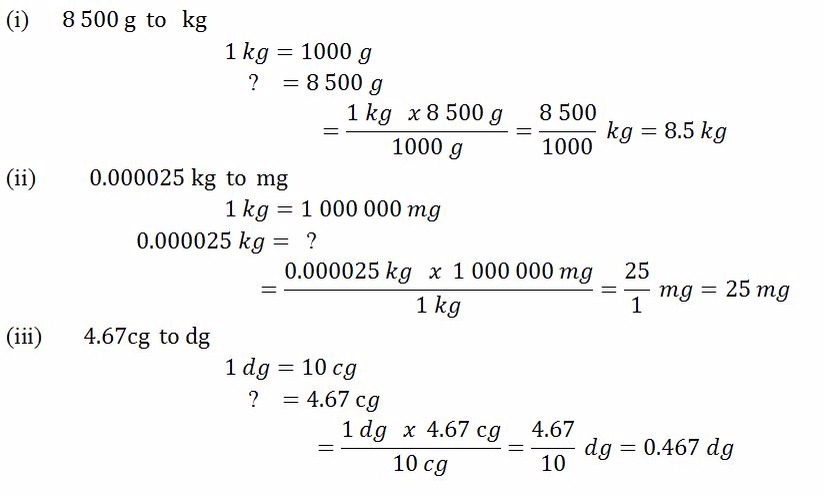
Example 3
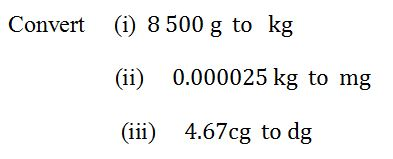
Solution
Example 4
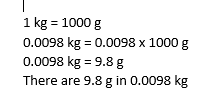
How many grams are there in 0.0098 kg?
Solution:
Units
Mathematics Form 1
A unit – is defined as a symbol or sign which is assigned to a number to describe a kind of measurement made
The units of time are of two types, smaller and larger units of time. Smaller units of time includes seconds, minutes, hours and days. Larger units of time includes week, month, year, decade, century,millennium.
Convertion of One Unit of Time to another
Convert one unit of time to another
The conversion of units of time to another can be done by considering the arrangement below
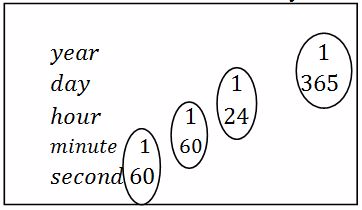
Example, from the circle above

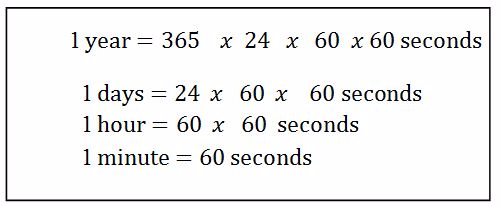
Also
Example 5
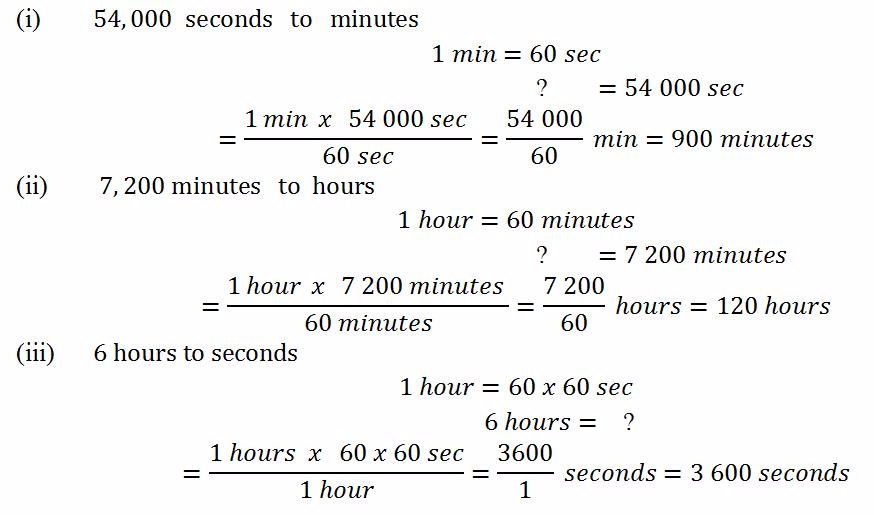
Convert
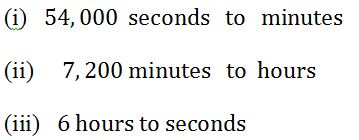
Solution
Example 6
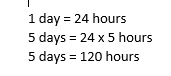
How many hours are there in 5 days?
Solution:
Convertion of Unit Time of 12 Hour Clock to 24 Hour Clock and Vice Versa
Read and convert unit time of 12 hour clock to 24 hour clock and vice versa
The hours can exist in two systems: 12- hour clock and 24 - hour clock.
A 12- hour clock has 12 hours between midnight and midday (a.m) and 12 hours between midday and midnight (p.m).
A day starts at mid night and ends after 24 hours.Times in the morning are the same in both systems. For times in the afternoon, convert by adding or subtracting 12 hours.
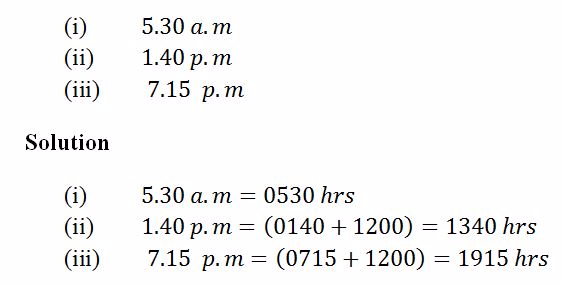
Example 7
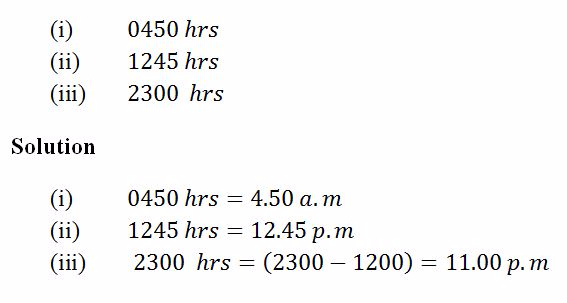
Convert the following times from the 12 - hour clock to 24 - hour clock.
Example 8
Convert the following times from the 24 - hour clock to 12 - hour clock.
Example 9
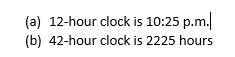
Change 25 minutes past 10 in the evening using; (a) 12-hour clock (b) 24- hour clock.
Solution:
Units
Mathematics Form 1
A unit – is defined as a symbol or sign which is assigned to a number to describe a kind of measurement made
Standard Unit of Measuring Capacity
State the standard unit of measuring capacity
Capacity is related to the volume.
Definitions:
- Capacity-is defined as the ability hold or contain something
- The S.I unit of capacity is litre.
- Volume –is defined as the amount of space occupied by a substance
- The S.I unit of volume is cubic metres (m3)
Capacity is related to the volume as follows:
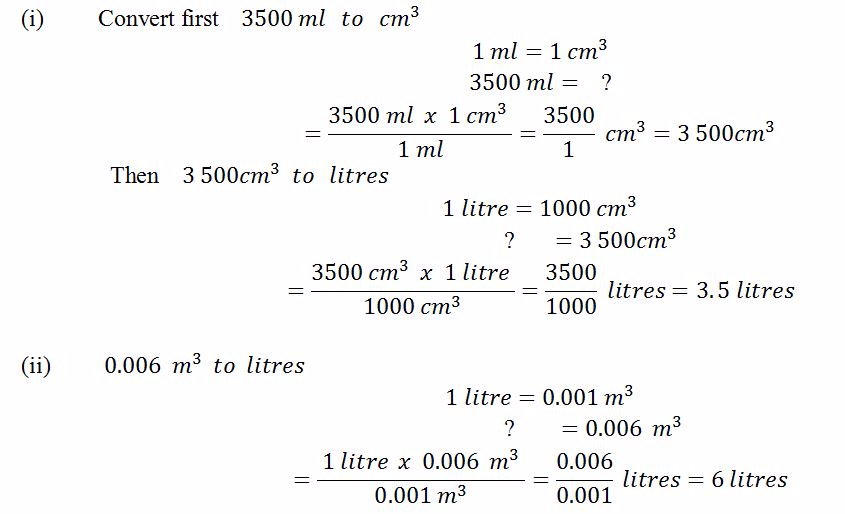
1 litre = 1000cm3 = 0.001m3 = 1dm3
Also 1 ml = 1 cm3
Other units related to litre are kiloliter (kl), hectoliter (hl), decalitre (dal), litre (l), deciliter (dl), centiliter (cl) and mililitre (ml).
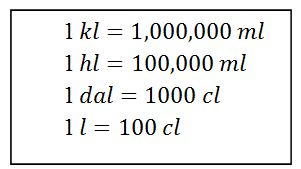
The conversion of one unit to another is done by considering the arrangement below
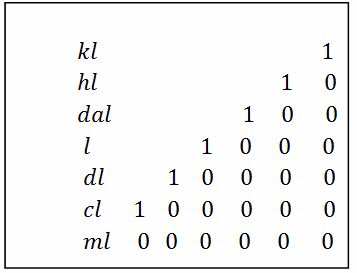
Example, from the above
The Litre in Daily Life
Use the litre in daily life
Example 10
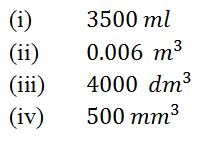
Convert the following units into
Solution
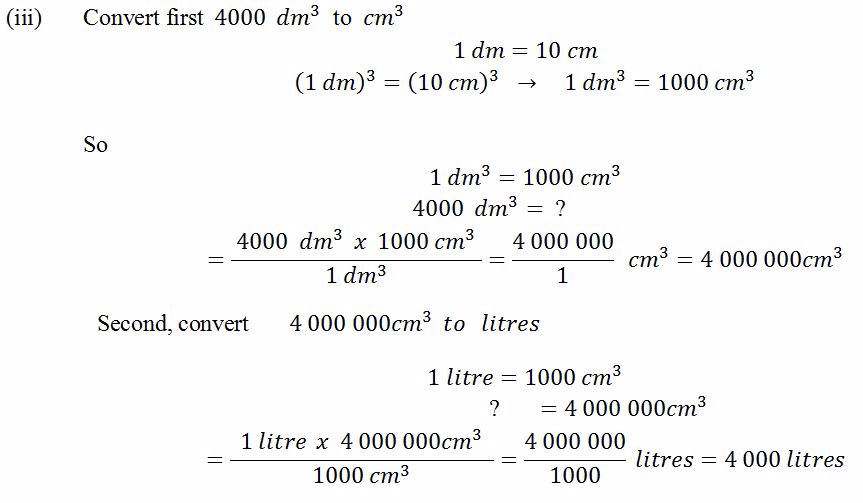
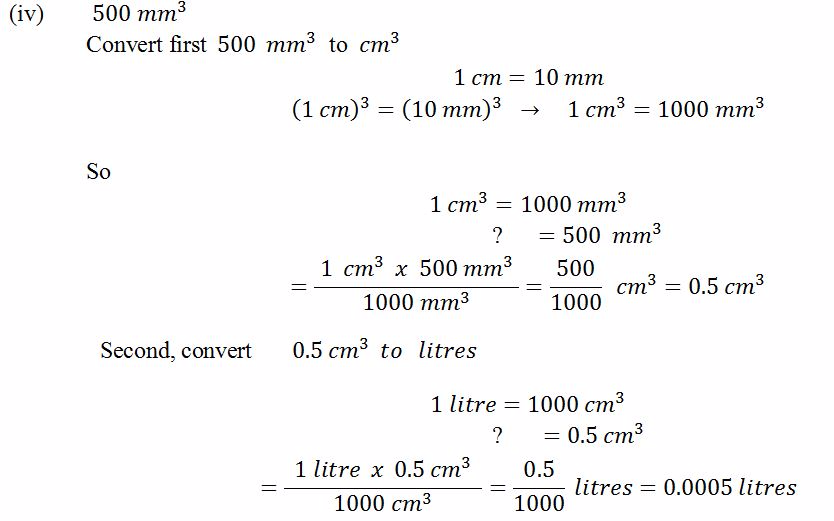
Example 11
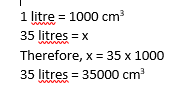
Change 35 litres into cm3
Solution:
Approximations
Mathematics Form 1
Measurements can be rounded to a certain number of significant figures.Approximation- is a process of rounding numbers to a certain degree of accuracy.A number can be rounded to a certain required place value such as to the nearest ten, hundred, and thousand
Rounding off Whole Numbers to Given Place Values
Round off whole numbers to given place values
STEPS
- When rounding a number, stand at the digit of the required place value, then look at the next digit to the right; if it is or more, round up (i.e, increase the digit of the required place value by 1) and if it is or less, do not change the digit of the required place value
- Replace all the remaining digits to the right of the required place value with the zeros
Example 1
The population of Tanzania in a census of 2002 was 42,850,671. Round this to the nearest
- million
- ten million
Solution
- The million digit is 2, since the next digit to the right is greater than 5, then we can increase 2 by 1 and put the remaining digits to the right of 2 zeros. There fore;42,850,671 ≈ 43,000,000
- The ten million digit is 4, since the next digit to the right is less than 5, then we do not change 4 but we put the remaining digits to the right of 4 zeros. There fore;42,850,671 ≈ 40,000,000
Example 2
A factory produces 426143 products per day. Round off the numbers to the thousands.
Solution:
6 is in the thousands place. The number to the right of 6 is 1. Then 426143 is 426000 rounded off to thousands.
Decimals to a Given Number of Decimal Place
Round off decimals to a given number of decimal place
STEPS
- When rounding a decimal, stand at the digit of the required decimal place, then look at the next digit to the right; if it is or more, round up (i.e increase the digit of the required decimal by 1) and if it is or less, do not change the digit of the required decimal place
- Replace all the remaining digits to the right of the required decimal place with the zeros
NOTE
- The first digit after the decimal point is the first decimal place, the second digit after the decimal point is the second decimal place e.t.c
- Example 0.568 is the first decimal place and is the second decimal place
Example 3
Round 0.24736 to the nearest
- 1 decimal place
- 2 decimal places
- 3 decimal places
Solution:
- 0.24736≈ 0.2 (1 d.p)
- 0.24736≈ 0.25 (2 d.p)
- 0.24736≈ 0.247 (3 d.p)
Example 4
Estimate the value of 58 x 61
Solution: 58 x 61 ≈ 60 x 60 =3600
Significant figures of a number - are the significant digits, counted from left of the number.The first significant figure must be non-zero; following significant figures may take any value.
A Number to a Given Number of Significant Figures
Write a number to a given number of significant figures
Is the number of significant digits including 0 if it is between the first and the last
Examples
- 13 – has two significant figures
- 709.43 – has five significant figures
- 0.0004001 – has four significant figures
STEPS
- When rounding a number to a certain significant figure, stand at the digit of the required significant figure, then look at the next digit to the right; if it is or more, round up (i.e increase the digit of the required significant figure by 1) and if it is or less, do not change the digit of the required significant figure
- Replace all the remaining digits to the right of the required significant figure with the zeros
Example 5
Given the number 45.274 round to
- 1 first significant figure
- 2 significant figure
- 3 significant figure
Solution
- 50
- 45
- 45.3
Example 6
Round 146 400 to
- 2 first significant figure
- 4 significant figure
- 3 significant figure
Solution
- 150 000
- 146 400
- 146 000
The Knowledge of Rounding Off of Numbers in Computations Involving Large Numbers and Small Numbers
Use the knowledge of rounding off of numbers in computations involving large numbers and small numbers
Approximation can be used in operation to check whether a calculation is correct or not, i.e in addition, subtraction, multiplication and divisione.g 446 x 45 = 20 070
The above calculation can be checked quickly whether it is correct or not by rounding each number to 1 significant figure and then multiply i.e 400 x 50 = 20 000
Therefore, the approximation of 20 000 is close to 20 0070 is correct.Before carrying an operation, each number in a calculation is rounded to 1 significant figure
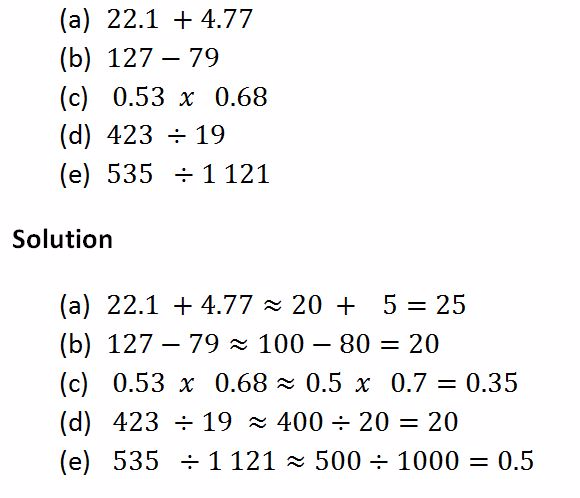
Example 7
Find the approximate value of
Example 8
A school trip of 32 people went to a tour, which costs a transport fee of 580/- each people. What was the approximate total transport cost?
Solution
32 × 580 ≈30×600 = 18 000
The approximate transport cost was 18 000/-
Example 9
Determine the number of decimal places of 10.12 x 0.08
Solution: 10.12 x 0.08 = 0.8096 has 4 decimal places
The Concept of a Point
Explain the concept of a point
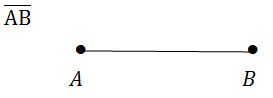
A point – is a smallest geometric figure which gives a position of object in a plane
A line segment – is a straight line joining two points in a plane
The Concept of a Point to Draw a Line
Extend the concept of a point to draw a line
A line segment – is a straight line joining two points in a plane
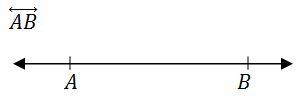
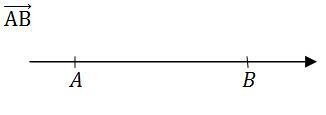
A line passing through two points e.g A and B and extends without end (i.e infinitely) in both directions is denoted by
The Difference Between a Line, a Line Segment and a Ray
Distinguish between a line, a line segment and a ray
A ray - is a line starting from a point, say A and pass through a point, say B and extends without end in one direction.It is denoted by
Geometry
Mathematics Form 1
Angles
Draw angles
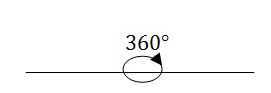
An angle – is a measure of an amount of turn. For instance, a complete turn has an angle of 360º
Measuring Angles of Different Size Using a Protractor
Measure angles of different size using a protractor
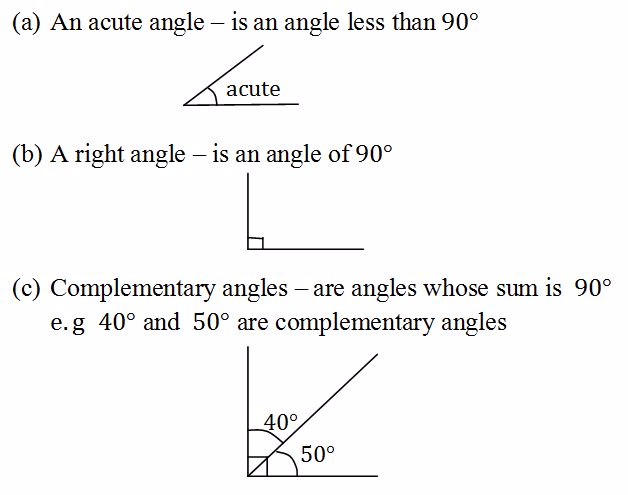
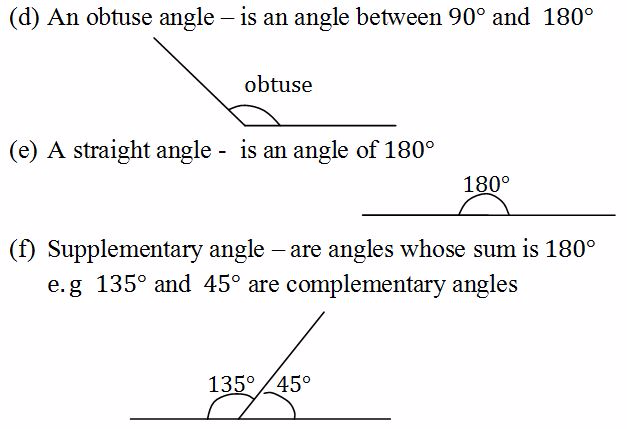
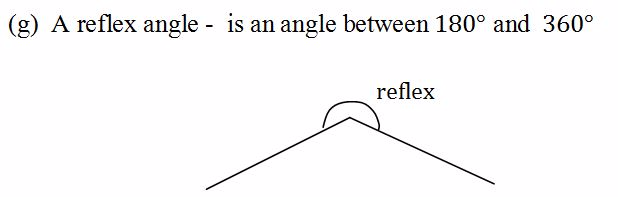
There are several types of angles including:- acute, right, complementary, obtuse, supplementary and reflex angle
Example 1
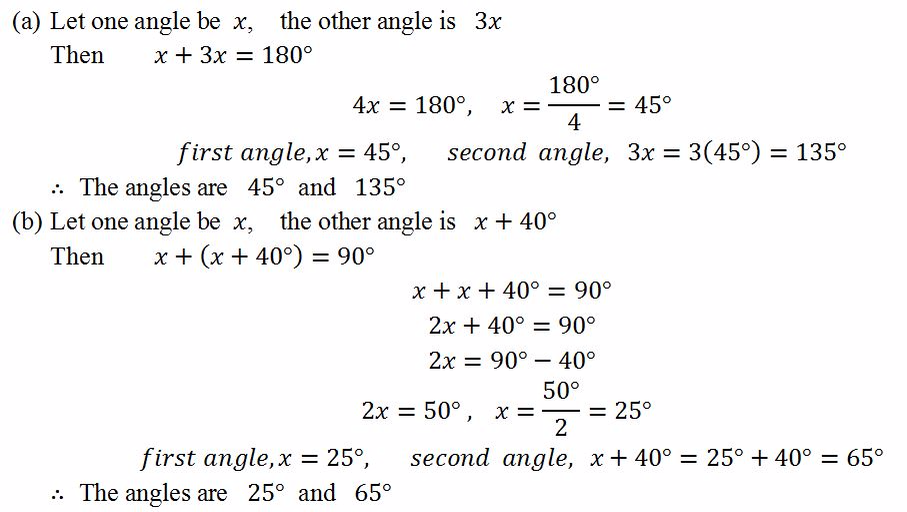
- Two angles are supplementary. One angle is three times the other. What are the angles?
- Two angles are complementary. One angle is 40º greater than the other. What are the angles?
Solution
Drawing Angles Using a Protractor
Draw angles using a protractor
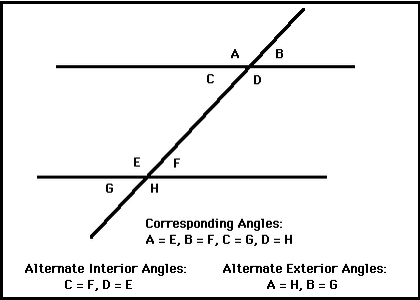
The angles formed by crossing lines includes vertically opposite angles, alternate angle and corresponding angles
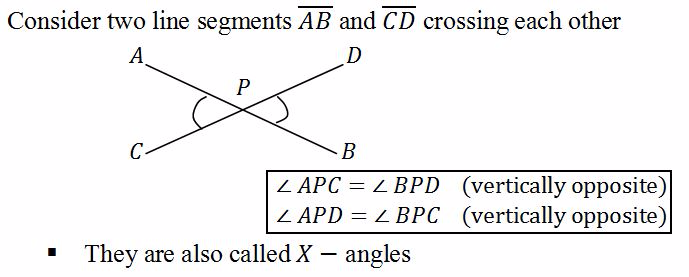
Vertically opposite angles
The angles on the opposite sides of the crossing lines are equal
Alternate angles
Consider a line segment crossing two parallel line segments. This line is called a transversal
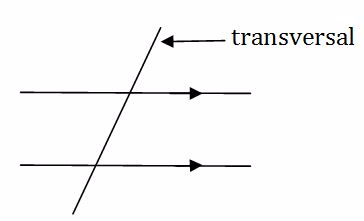
The angles within the parallel line segments on the opposite sides of the transversal are equal
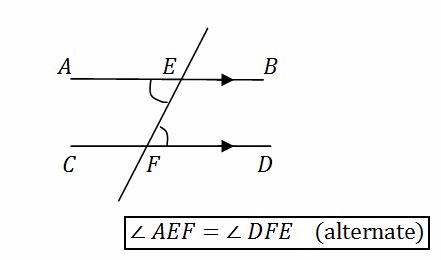
They are also called Z - angles
<!--[endif]-->Corresponding angles
The angles on the same side of the transversal and on the same side of the parallel lines are equal.They are called corresponding angles and sometimes called F - angles
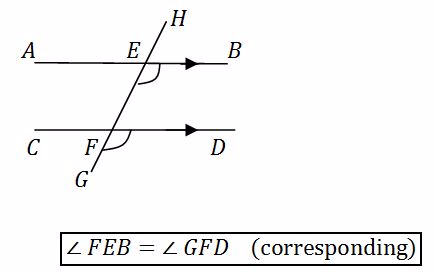
There are also three other pairs of corresponding angles in the diagram above.When showing that two angles are equal you must give reason whether they are vertically opposite, or alternate or corresponding angles.
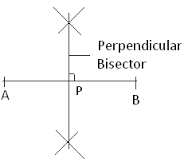
Construction of a Perpendicular Bisector to a Line Segment
Construct a perpendicular bisector to a line segment
Perpendicular Bisector to a Line Segment is shown below
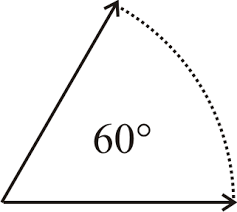
Contruction of an Angle of 60° Using a Pair of Compasses
Construct an angle of 60° using a pair of compasses
Angle of 60°
Bisection of a Given Angle
Bisect a given angle
Activity 1
Bisect a given angle
Copying a Given Angle by Construction
Copy a given angle by construction
Activity 2
Copy a given angle by construction
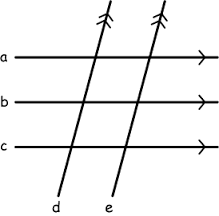
Parallel Lines
Construct parallel lines
Parallel lines can be shown as below:
Different Types of Angles Formed by Parallel Lines and a Transversal
Identify different types of angles formed by parallel lines and a transversal
Different types of angles are shown below.
Geometry
Mathematics Form 1
A Polygon and a Region
Describe a polygon and a region
A polygon is a plane figure whose sides are three or more co planar segments that intersect only at their endpoints. Consecutive sides cannot be collinear and no more than two sides can meet at any one vertex.
A polygonal region is defined as a polygon and its interior.
Different Types of Triangles
Construct different types of triangles
A triangle – is a polygon with three sides.The sides connect the points called vertices.
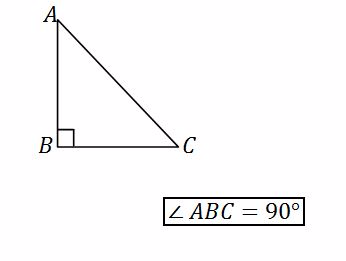
A right – angled triangle – has one angle equal to 90º
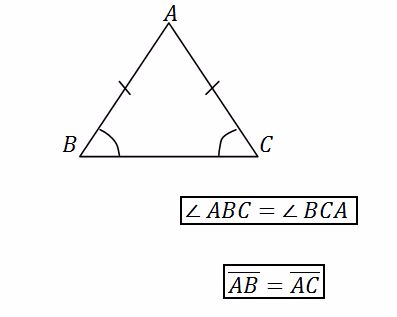
An isosceles triangle – has two equal sides and two equal angles
An equilateral triangle – has three equal sides and all angles equal
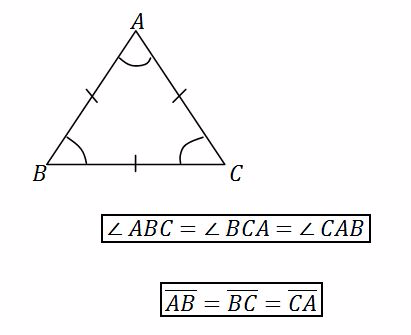
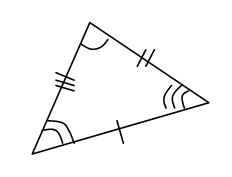
NOTE: A triangle with all sides different and all angles different is called scalene triangle.
A triangle with vertices A, B and C is denoted as

A triangle has two kinds of angles
- Interior angles
- Exterior angles
Interior angle – is an angle inside the triangle.The sum of interior angles of a triangle is 180.
Example, consider the triangle below
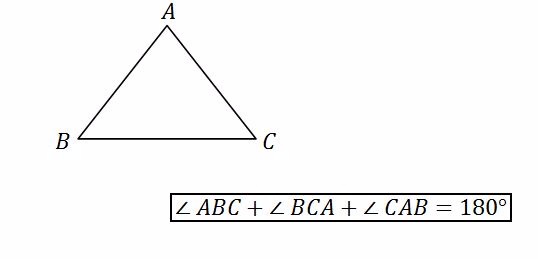
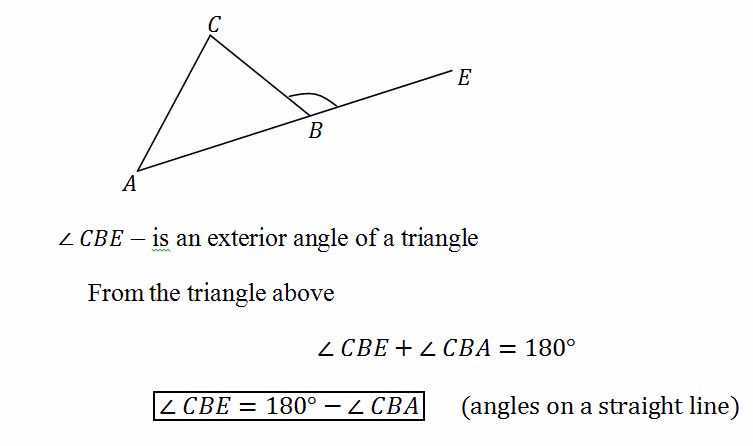
Exterior angle - is an angle outside the triangle. Consider the triangle below
Example 2
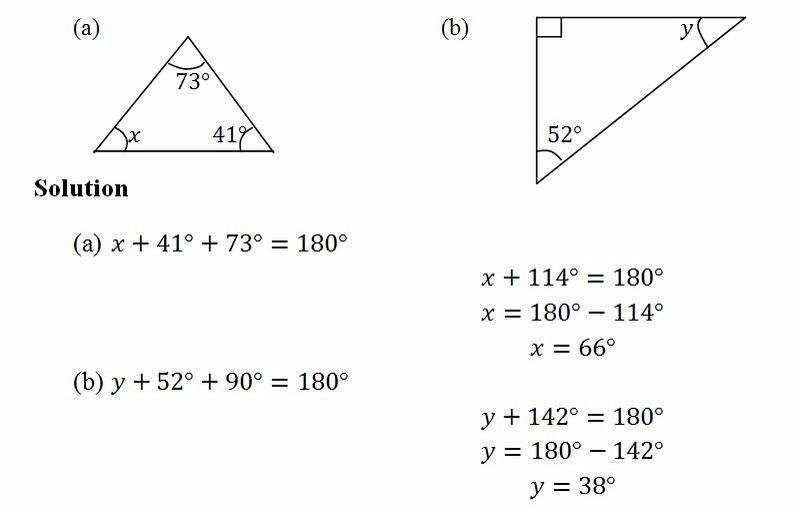
Find the angles x and y in the diagrams below
Different Quadrilaterals
Construct different quadrilaterals
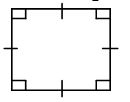
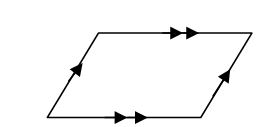
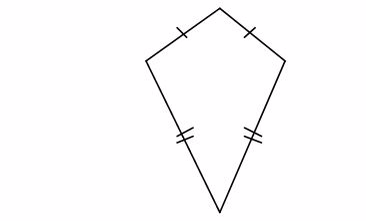
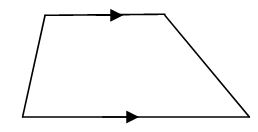
A quadrilateral – is a polygon with four sides. Examples of quadrilaterals are a square, a rectangle, a rhombus, a parallelogram, a kite and a trapezium
A square – has equal sides and all angles are 90º
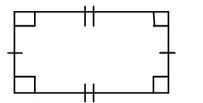
A rectangle – has two pairs of opposite sides equal and all angles are 90º
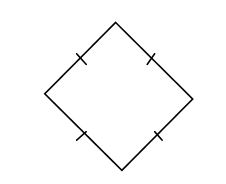
A rhombus – has all sides equal.Opposite angles are also equal
A parallelogram – has two pairs of opposite sides equal.Opposite angles are also equal
A kite – has two pairs of adjacent sides equal.One pair of opposite angles are also equal
A trapezium – has one pair of opposite sides pair
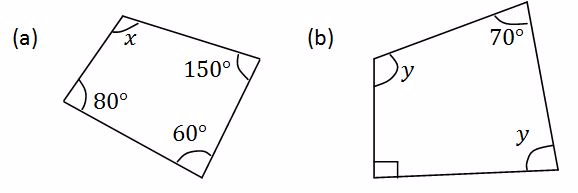
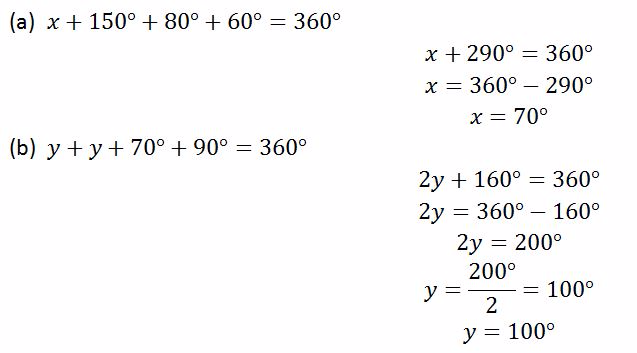
Any quadrilateral is made up of two triangles. Consider the below quadrilateral.
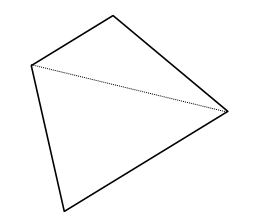
Sum of angles of quadrilateral = 2 ×180º = 360º
Example 3
Find the angles x and y in the diagrams below
Solution
Geometry
Mathematics Form 1
A Circle
Draw a circle
To make a circle: Draw a curve that is "radius" away from a central point.
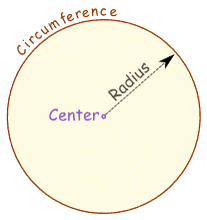
And so:All points are the same distance from the center.
You can draw it yourself: Put a pin in a board, put a loop of string around it, and insert a pencil into the loop. Keep the string stretched and draw the circle!
Different Parts of a Circle
Describe different parts of a circle
The radius of the circle is a straight line drawn from the center to the boundary line or the circumference. The plural of the word radius is radii.
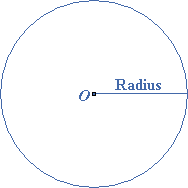
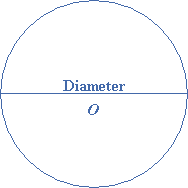
The diameter is the line crossing the circle and passing through the center. It is the twice of the length of the radius.
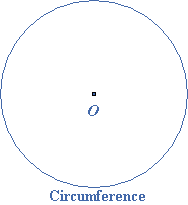
The circumference of a circle is the boundary line or the perimeter of the circle.
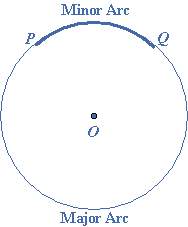
An arc is a part of the circumference between two points or a continuous piece of a circle. The shorter arc between P and Q is called the minor arc. The longer arc between Q and P is called the major arc.
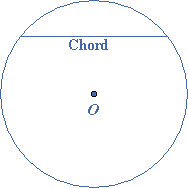
The chord is a straight line joining two points on the circumference points of a circle. The diameter is a special kind of the chord passing through the center.
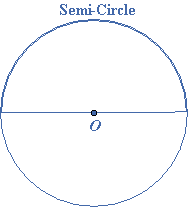
A semi-circle is an arc which is half of the circumference.
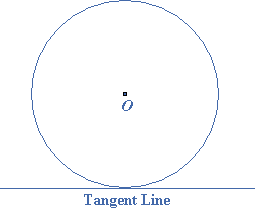
A tangent is a straight line which touches the circle. It does not cut the circumference. The point at which it touches, is called the point of contact.
Algebra
Mathematics Form 1
An algebraic expression – is a collection of numbers, variables, operators and grouping symbols. Variables - are letters used to represent one or more numbers
Symbols to form Algebraic Expressions
Use symbols to form algebraic expressions
The parts of an expression collected together are called terms
Example
- x + 2x – are called like terms because they have the same variables
- 5x +9y – are called unlike terms because they have different variables
An algebraic expression can be evaluated by replacing or substituting the numbers in the variables
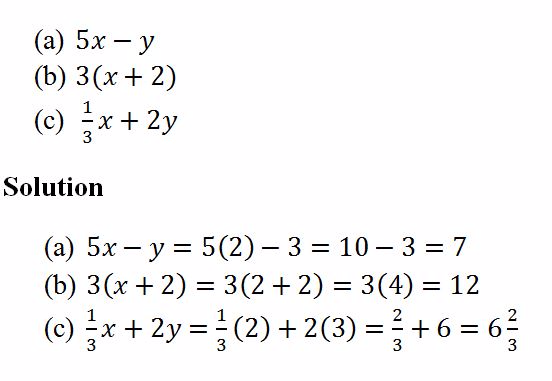
Example 1
Evaluate the expressions below, given that x = 2 and y = 3
Example 2
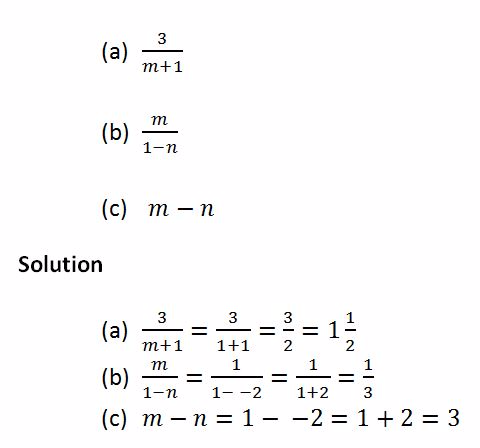
Evaluate the expressions below, given that m = 1 and n = - 2
An expression can also be made from word problems by using letters and numbers
Example 3
A rectangle is 5 cm long and w cm wide. What is its area?
Solution
Let the area be A.
Then
A = length× width
A = 5w cm2
Simplifying Algebraic Expressions
Simplify algebraic expressions
Algebraic expressions can be simplified by addition, subtraction, multiplication and division
Addition and subtraction of algebraic expression is done by adding or subtracting the coefficients of the like terms or letters
Coefficient of the letter – is the number multiplying the letter
Multiplication and division of algebraic expression is done on the coefficients of both like and unlike terms or letters
Example 4
Simplify the expressions below
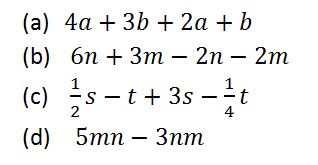
Solution
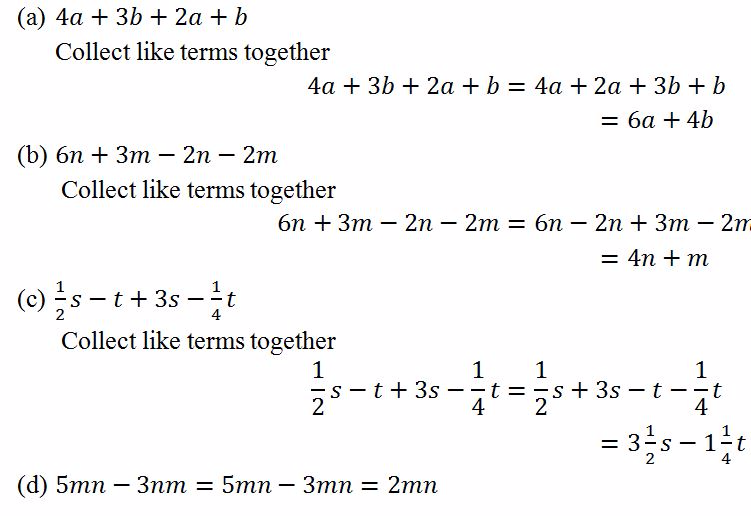
An equation – is a statement that two expressions are equal
An Equation with One Unknown
Solve an equation with one unknown
An equation can have one variable (unknown) on one side or two variables on both sides.
When you shift a number or term from one side of equation to another, its sign changes
- If it is positive, it becomes negative
- If it is negative, it becomes positive
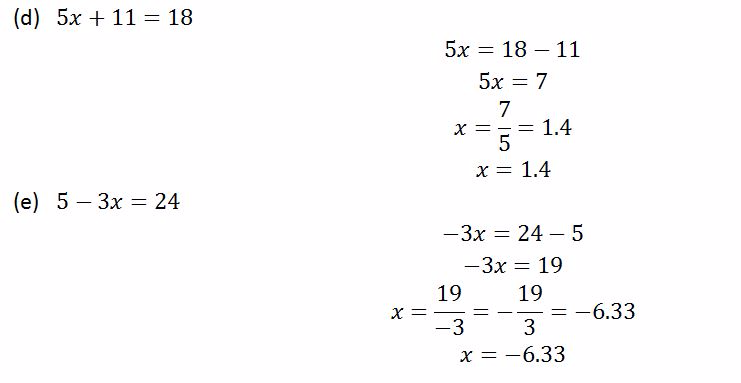
Example 5
Solve the following equations
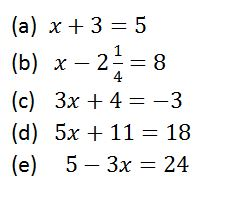
Solution
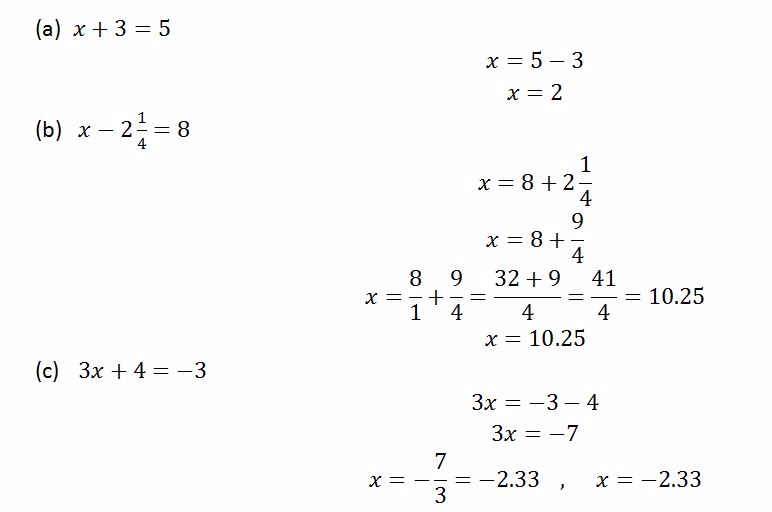
An Equation from Word Problems
Form and solve an equation from word problems
Some word problems can be solved by using equations as shown in the below examples
Example 6
Naomi is 5 years young than Mariana. The total of their ages 33 years. How old is Mariana?
Solution
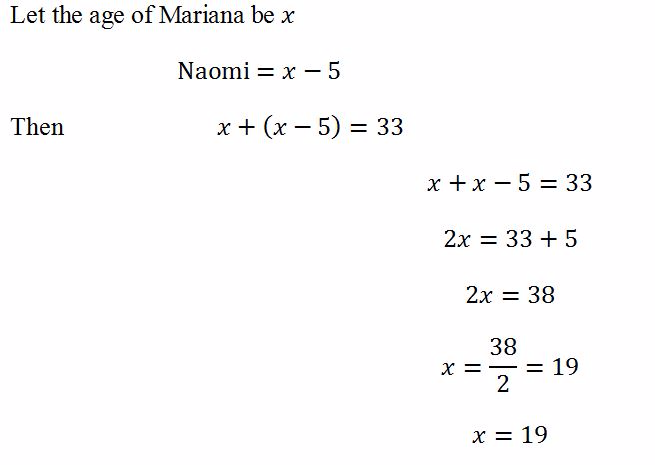
Mariana is 19 years
Algebra
Mathematics Form 1
An algebraic expression – is a collection of numbers, variables, operators and grouping symbols. Variables - are letters used to represent one or more numbers
Simultaneous Equations
Solve simultaneous equations
Simultaneous equations – are groups of equations containing multiple variables
Example 7
Examples of simultaneous equation

A simultaneous equation can be solved by using two methods:
- Elimination method
- Substitution method
ELIMINATION METHOD
STEPS
- Choose a variable to eliminate e.g x or y
- Make sure that the letter to be eliminated has the same coefficient in both equations and if not, multiply the equations with appropriate numbers that will give the letter to be eliminated the same coefficient in both equations.
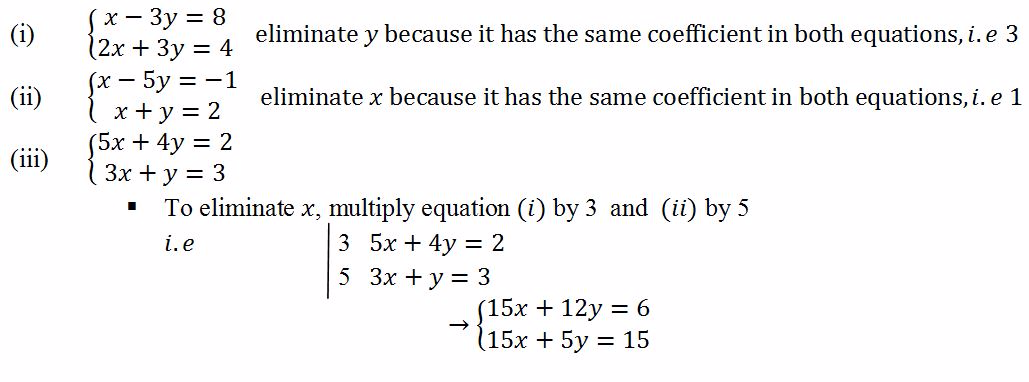
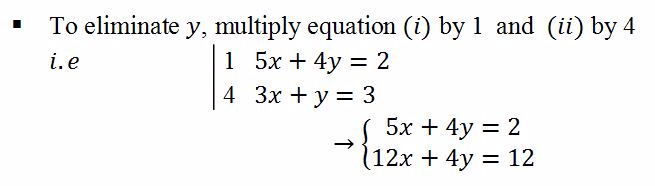
- If the signs of the letter to be eliminated are the same, subtract the equations
- If the signs of the letter to be eliminated are different, add the equations
Example 8
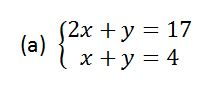
Solve the following simultaneous equations by elimination method
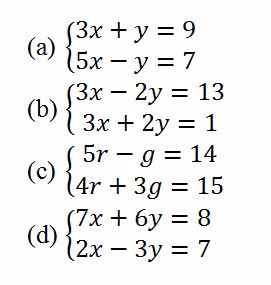
Solution
- Eliminate y
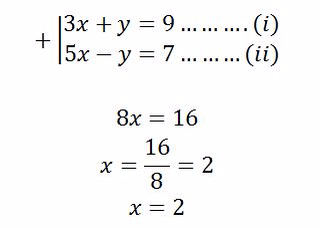
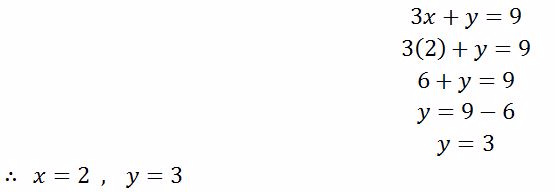
To find y put x = 2 in either equation (i) or (ii)
From equation (i)
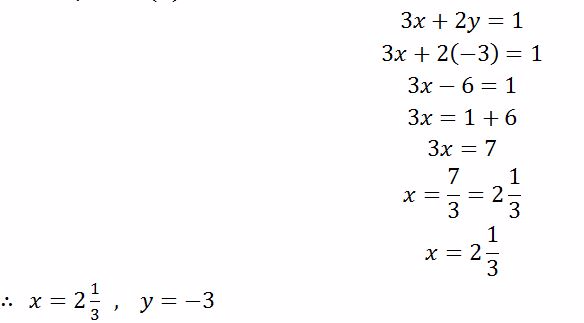
(b)Eliminate x
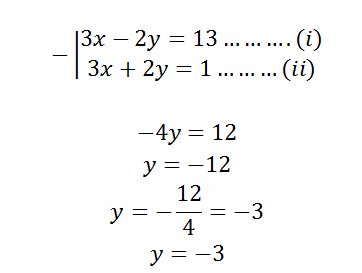
In order to find y, put x = 2 in either equation (i) or (ii)
From equation (ii)
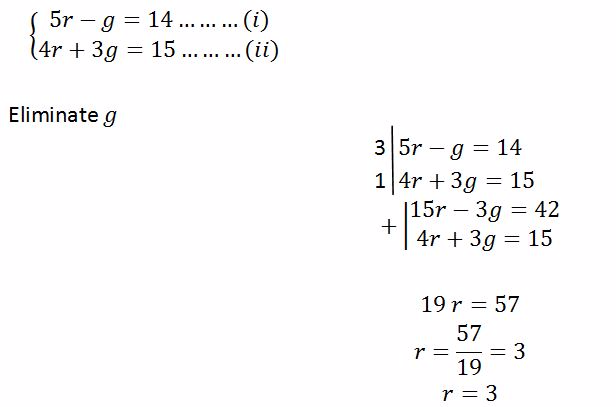
(c) Given
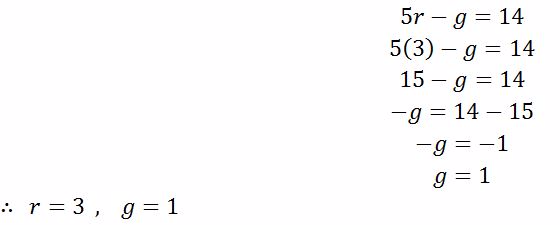
To find g put r = 3 in either equation (i) or (ii)
From equation (i)
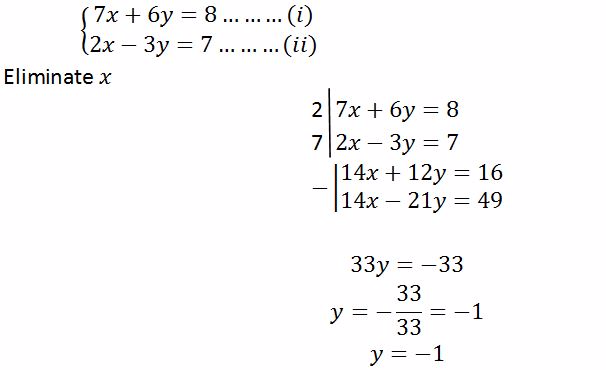
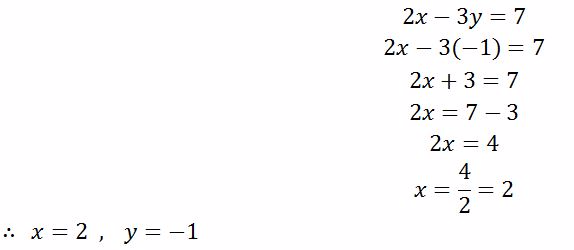
(d) Given
To find x, put y = - 1 in either equation(i) or (ii)
From equation (ii)
BY SUBSTITUTION
Tutorial on Substitution Method in solving equation with two unknown
Tutorial Created by Willbald Mvungi-Ilboru Secondary
STEPS
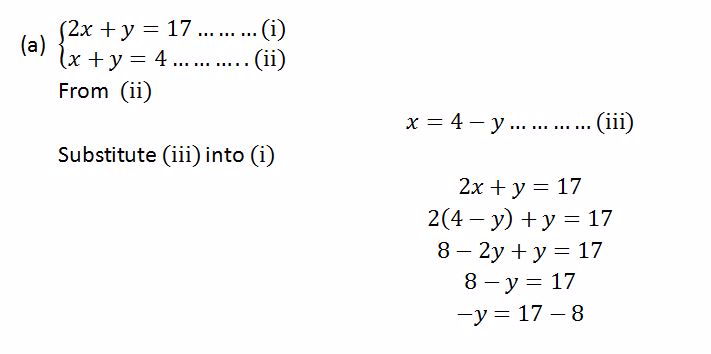
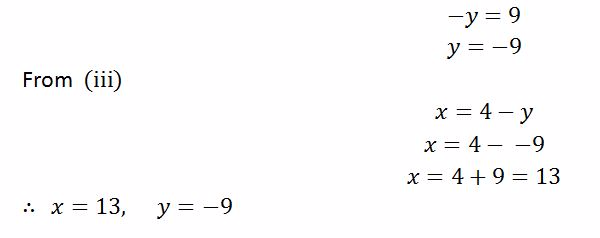
- Make the subject one letter in one of the two equation given
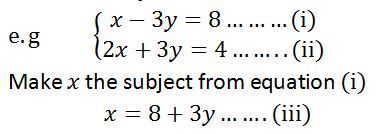
- Substitute the letter in the remaining equation and proceed as in case of elimination
Example 9
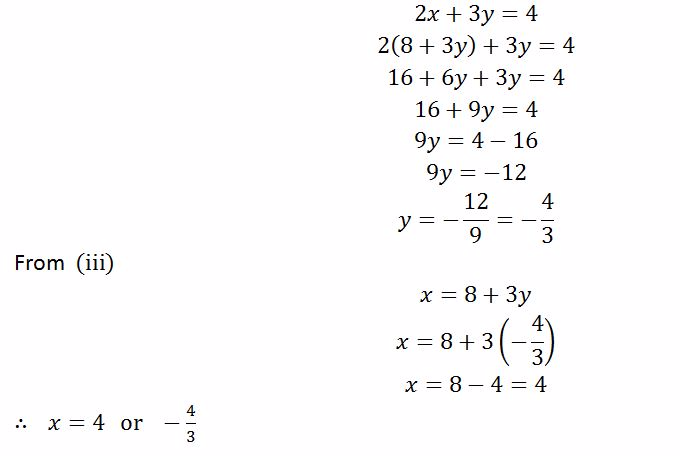
Solve the following simultaneous equations by substitution method
Solution
Linear Simultaneous Equations from Practical Situations
Solve linear simultaneous equations from practical situations
Simultaneous equations can be used to solve problems in real life involving two variables
Example 10
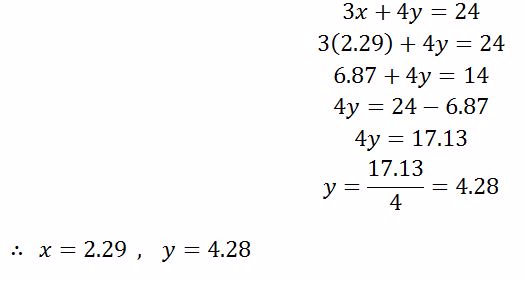
If 3 Mathematics books and 4 English books weighs 24 kg and 5 Mathematics books and 2 English books weighs 20 kg, find the weight of one Mathematics book and one English book.
Solution
Let the weight of one Mathematics book = x and
Let the weight of one English book = y
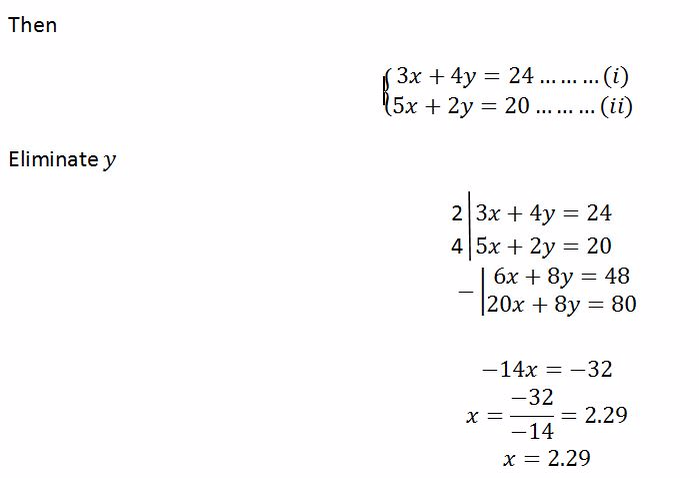
To find y, put x = 2.29 in either equation (i) or (ii)
From equation(i).
Algebra
Mathematics Form 1
An algebraic expression – is a collection of numbers, variables, operators and grouping symbols. Variables - are letters used to represent one or more numbers
An inequality – is a mathematical statement containing two expressions which are not equal. One expression may be less or greater than the other.The expressions are connected by the inequality symbols<,>,≤ or≥.Where< = less than,> = greater than,≤ = less or equal and ≥ = greater or equal.
Linear Inequalities with One Unknown
Solve linear inequalities in one unknown
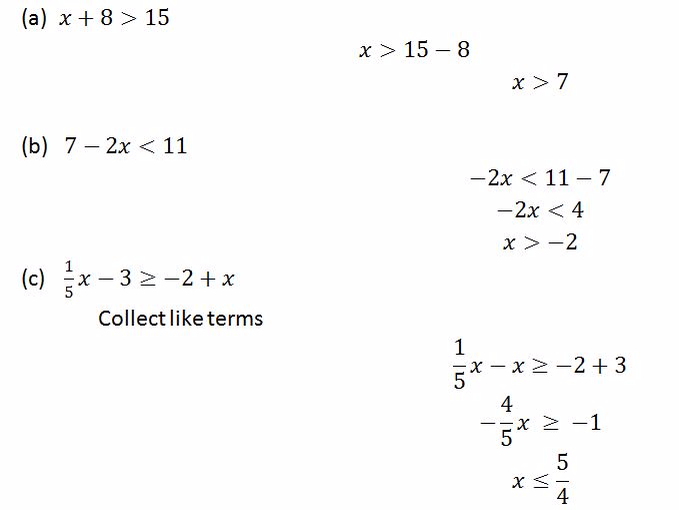
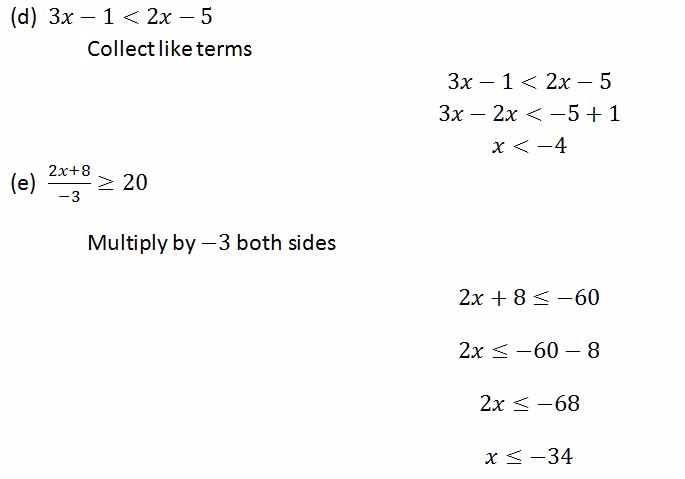
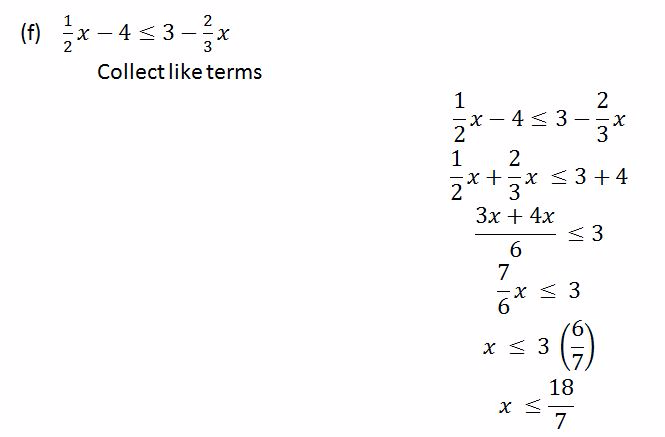
An inequality can be solved by collecting like terms on one side.Addition and subtraction of the terms in the inequality does not change the direction of the inequality.Multiplication and division of the sides of the inequality by a positive number does not change the direction of the inequality.But multiplication and division of the sides of the inequality by a negative number changes the direction of the inequality
Example 11
Solve the following inequalities

Solution
Linear Inequalities from Practical Situations
Form linear inequalities from practical situations
To represent an inequality on a number line, the following are important to be considered:
- The endpoint which is not included is marked with an empty circle
- The endpoint which is included is marked with a solid circle
Example 12
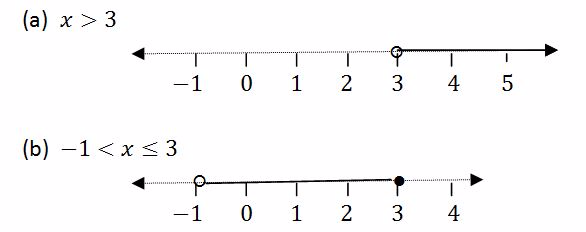
Compound statement – is a statement made up of two or more inequalities
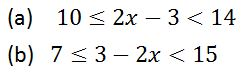
Example 13
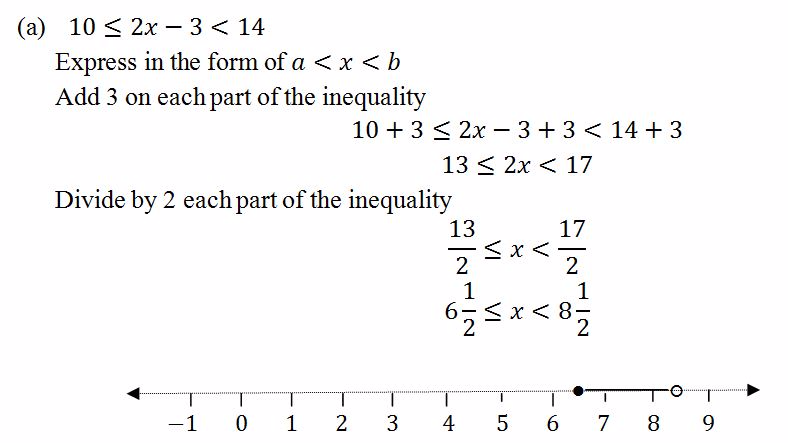
Solve the following compound inequalities and represent the answer on the number line
Solution
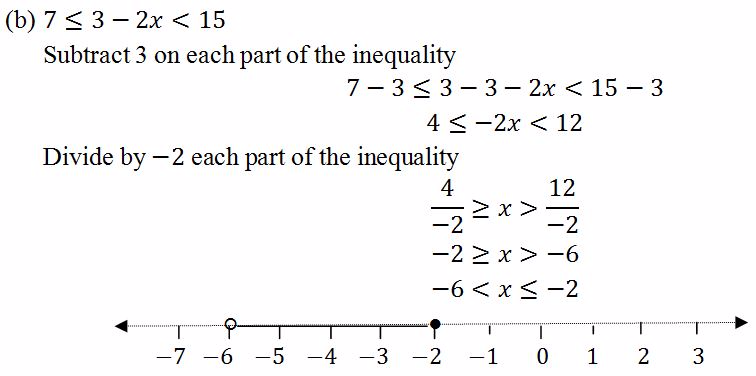
A Rational Number
Define a rational number
A Rational Number is a real number that can be written as a simple fraction (i.e. as a ratio). Most numbers we use in everyday life are Rational Numbers.
| Number | As a Fraction | Rational? |
|---|---|---|
| 5 | 5/1 | Yes |
| 1.75 | 7/4 | Yes |
| .001 | 1/1000 | Yes |
| -0.1 | -1/10 | Yes |
| 0.111... | 1/9 | Yes |
| √2(square root of 2) | ? | NO ! |
The square root of 2 cannot be written as a simple fraction! And there are many more such numbers, and because they are not rational they are called Irrational.
The Basic Operations on Rational Numbers
Perform the basic operations on rational numbers
Addition of Rational Numbers:
To add two or morerational numbers, the denominator of all the rational numbers should be the same. If the denominators of all rational numbers are same, then you can simply add all the numerators and the denominator value will the same. If all the denominator values are not the same, then you have to make the denominator value as same, by multiplying the numerator and denominator value by a common factor.
Example 1
1⁄3+4⁄3=5⁄3
1⁄3 +1⁄5=5⁄15 +3⁄15 =8⁄15
Subtraction of Rational Numbers:
To subtract two or more rational numbers, the denominator of all the rational numbers should be the same. If the denominators of all rational numbers are same, then you can simply subtract the numerators and the denominator value will the same. If all the denominator values are not the same, then you have to make the denominator value as same by multiplying the numerator and denominator value by a common factor.
Example 2
4⁄3 -2⁄3 =2⁄3
1⁄3-1⁄5=5⁄15-3⁄15=2⁄15
Multiplication of Rational Numbers:
Multiplication of rational numbers is very easy. You should simply multiply all the numerators and it will be the resulting numerator and multiply all the denominators and it will be the resulting denominator.
Example 3
4⁄3x2⁄3=8⁄9
Division of Rational Numbers:
Division of rational numbers requires multiplication of rational numbers. If you are dividing two rational numbers, then take the reciprocal of the second rational number and multiply it with the first rational number.
Example 4
4⁄3÷2⁄5=4⁄3x5⁄2=20⁄6=10⁄3
Irrational Numbers
Define irrational numbers
Our mathematics expert has prepared the video Irrational number, take your time to go through
Tutorial Created by Willbald Mvungi-Ilboru Secondary
An irrational number is areal numberthat cannot be reduced to any ratio between anintegerpand anatural numberq. The union of the set of irrational numbers and the set ofrational numbers forms the set of real numbers. In mathematical expressions, unknown or unspecified irrationals are usually represented byuthroughz. Irrational numbers are primarily of interest to theoreticians. Abstract mathematics has potentially far-reaching applications in communications and computer science, especially in data encryption and security.
Examples of irrational numbers are √2 (the square root of 2), the cube root of 3, the circular ratiopi, and the naturallogarithmbasee. The quantities√2andthe cube root of 3are examples ofalgebraic numbers. Pi andeare examples of special irrationals known as atranscendental numbers. The decimal expansion of an irrational number is always nonterminating (it never ends) and nonrepeating (the digits display no repetitive pattern)
Real Numbers
Define real numbers
The type of number we normally use, such as 1, 15.82, −0.1, 3/4, etc.Positive or negative, large or small, whole numbers or decimal numbers are all Real Numbers.
They are called "Real Numbers" because they are not Imaginary Numbers.
Absolute Value of Real Numbers
Find absolute value of real numbers
The absolute value of a number is the magnitude of the number without regard to its sign. For example, the absolute value of ? ?? ? written as ? . The sign before ? is ignored. This is because the distance represented is the same whether positive or negative. For example, a student walking 5 steps forward or 5 steps backwards will be considered to have moved the same distance from where she originally was, regardless of the direction.
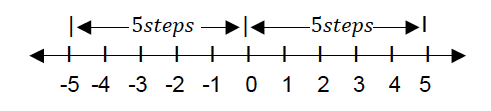
The 5 steps forward (+5) and 5 steps backward (-5) have an absolute value of 5
Thus |?| = ? when ? is positive (? ≥ 0), but |?| = −? when ? is negative (? ≤ 0).
For example, |3| = 3 since 3 is positive (3 ≥ 0) And −3 = (−3) =3 since −3 is negative (3 ≤ 0)
Related Practical Problems
Solve related practical problems
Example 5
Solve for ? ?? |?| = 5
Solution
For any number ?, |?| = 5, there are two possible values. Either ?,= +5 ?? ? = 5
Example 6
Solve for ?, given that |? + 2| =4
Solution
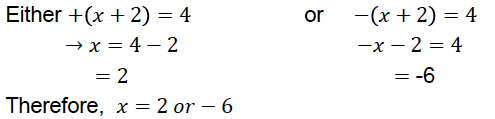
Exercise 1
1. What must be added to -1 to make 2 ?
2. Solve for x if /3x-1/ = 5
3. Represent on a number line the solution for /2x-1/=3
4. Represent the following on a number line -3≤x≤3
5. Sketch the graph of the equation x-2y=4
A ratio – is a way of comparing quantities measured in the same units
Examples of ratios
- A class has 45 girls and 40 boys. The ratio of number of boys to the number of girls = 40: 45
- A football ground 100 𝑚 long and 50 𝑚 wide. The ratio of length to the width = 100: 50
NOTE: Ratios can be simplified like fractions
- 40: 45 = 8: 9
- 100: 50 = 2: 1
A Ratio in its Simplest Form
Express a ratio in its simplest form
Example 1
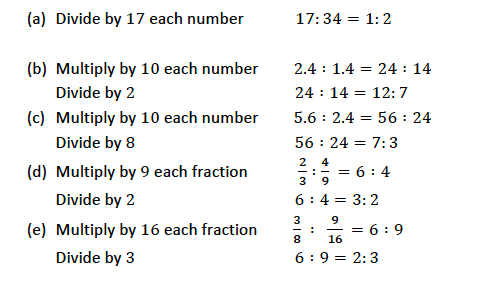
Simplify the following ratios, giving answers as whole numbers
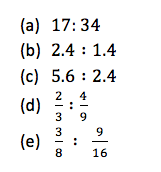
Solution
A Given Quantity into Proportional Parts
Divide a given quantity into proportional parts
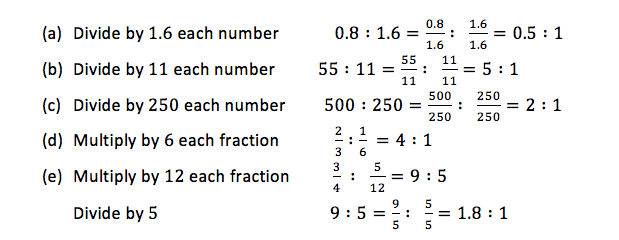
Example 2
Express the following ratios in the form of
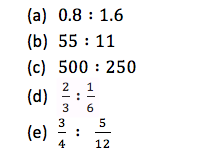
Solution
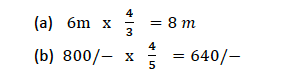
To increase or decrease a certain quantity in a given ratio, multiply the quantity with that ratio
Example 3
- Increase 6 𝑚 in the ratio 4 ∶ 3
- Decrease 800 /− in the ratio 4 ∶ 5
Solution
Profit or Loss
Find profit or loss
If you buy something and then sell it at a higher price, then you have a profit which is given by: Profit = selling price − buying price
If you buy something and then sell it at a lower price, then you have a loss which is given by: Loss = buying price − selling price
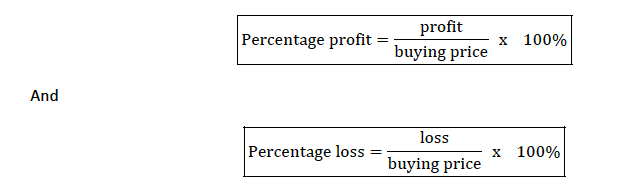
The profit or loss can also be expressed as a percentage of buying price as follows:
Percentage Profit and Percentage Loss
Calculate percentage profit and percentage profit and percentage loss
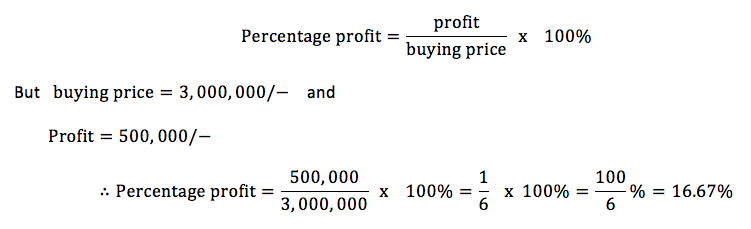
Example 4
Mr. Richard bought a car for 3, 000, 000/− and sold for 3, 500, 000/−. What is the profit and percentage profit obtained?
Solution
Profit= selling price − buying price = 3,500,000-3,000,000=500,000
Therefore the profit obtained is 500,000/-
Example 5
Eradia bought a laptop for 780,000 tshs, and sell it for 720000 tshs, find the percentage loss.
Solution
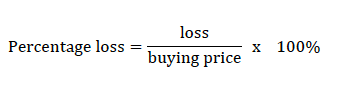
But buying price = 780, 000/− and loss = buying price − selling price = 780, 000 − 720, 000 = 60, 000/−

Simple Interest
Calculate simple interest
The amount of money charged when a person borrows money e. g from a bank is called interest (I)
The amount of money borrowed is called principle (P)
To calculate interest, we use interest rate (R) given as a percentage and is usually taken per year or per annum (p.a)

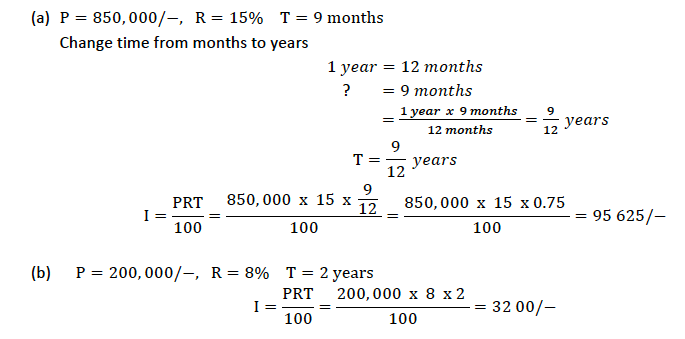
Example 6
Calculate the simple interest charged on the following
- 850, 000/− at 15% per annum for 9 months
- 200, 000/− at 8% per annum for 2 years
Solution
Real Life Problems Related to Simple Interest
Solve real life problems related to simple interest
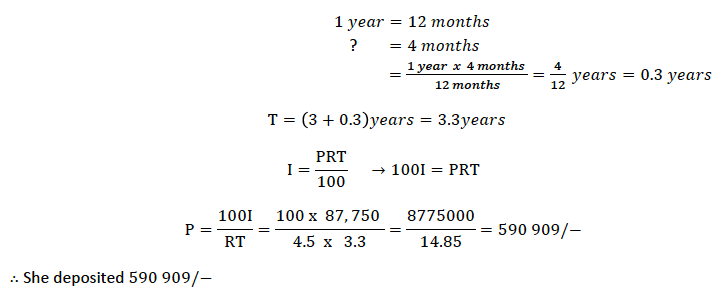
Example 7
Mrs. Mihambo deposited money in CRDB bank for 3 years and 4 months. A t the end of this time she earned a simple interest of 87, 750/− at 4.5% per annum. How much had she deposited in the bank?
Solution
Given I = 87, 750/− R = 4.5% % T = 3 years and 4 months
Change months to years
Exercise 1
1. A metal is composed of copper and zinc in the ratio3:2 by volume. Find the volume of a piece of the metal which contains 42 cm3 of copper.
2. A person borrows tshs 40,000/= for a period of 6 years at 20% simple interest per annum. Calculate the total amount to be repaid.
3. A house was bought for tsh 1,500,000/= and sold for tsh 1,800,000/=. What was the percentage profit?
4. Tsh 2000/= was invested at 12% per annum simple interest. The investment is now worth tsh 2960/=. How many years ago was the money invested?
5. Abraham, Abdiel and Adon share 132000/=. Abraham gets 5/11 of the money, Abdiel gets 4/11 and Adon gets 2/11 of the money. How much does each get?
The Coordinates of a Point
Read the coordinates of a point
Coordinates of a points – are the values of ? and ? enclosed by the bracket which are used to describe the position of a point in the plane
The plane used is called ?? − plane and it has two axis; horizontal axis known as ? − axis and; vertical axis known as ? − axis
A Point Given its Coordinates
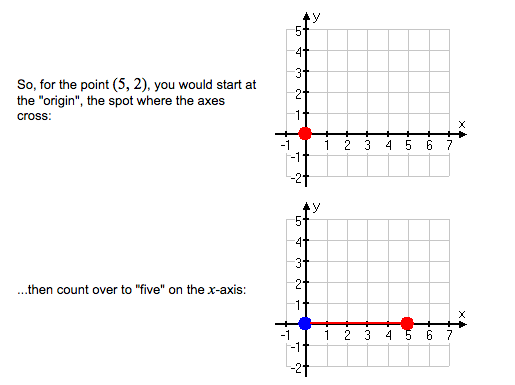
Plot a point given its coordinates
Suppose you were told to locate (5,2) on the plane. Where would you look? To understand the meaning of (5, 2), you have to know the following rule: The x-coordinate (always comes first). The first number (the first coordinate) is always on the horizontal axis.
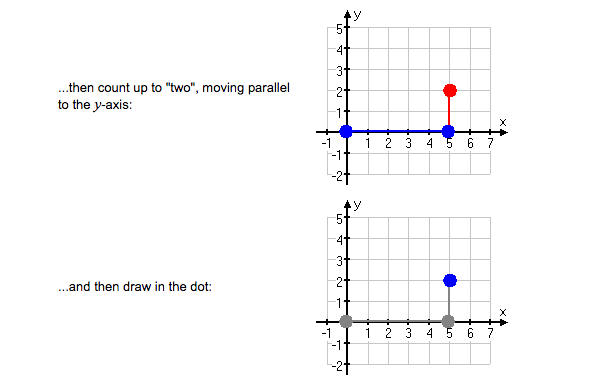
A Point on the Coordinates
Locate a point on the coordinates
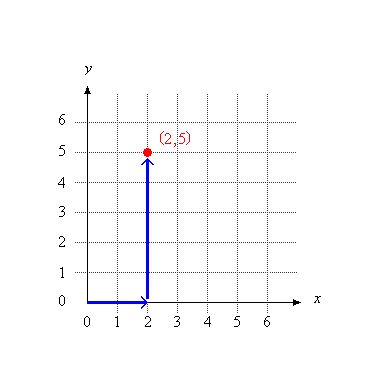
The location of (2,5) is shown on the coordinate grid below. Thex-coordinate is 2. They-coordinate is 5. To locate (2,5), move 2 units to the right on thex-axis and 5 units up on they-axis.
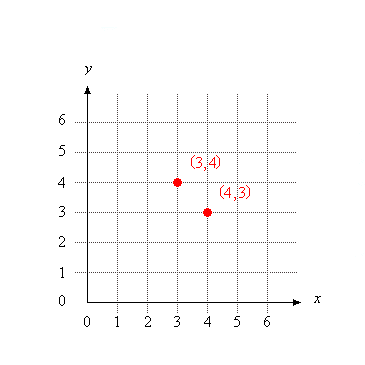
The order in which you writex- andy-coordinates in an ordered pair is very important. Th ex-coordinate always comes first, followed by they-coordinate. As you can see in the coordinate grid below, the ordered pairs (3,4) and (4,3) refer to two different points!
The Gradient of a Line Given Two Points
Calculate the gradient of a line given two points
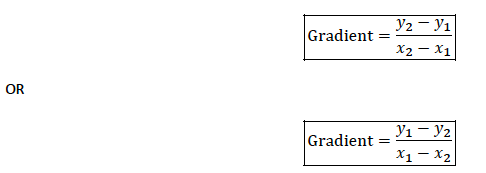
Gradient or slope of a line – is defined as the measure of steepness of the line. When using coordinates, gradient is defined as change in ? to the change in ?.
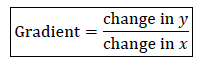
Consider two points ? (?1, ?1)and (? ?2, ?2), the slope between the two points is given by:
Example 1
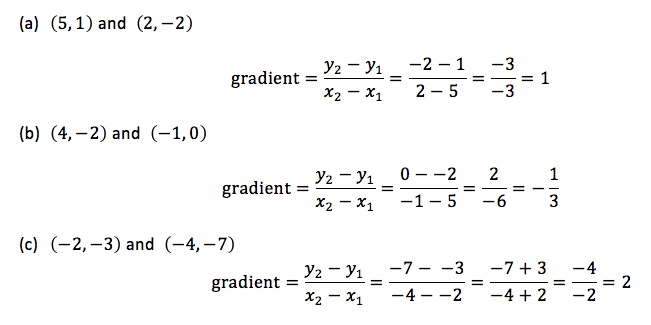
Find the gradient of the lines joining:
- (5, 1) and (2,−2)
- (4,−2) and (−1, 0)
- (−2,−3) and (−4,−7)
Solution
Example 2
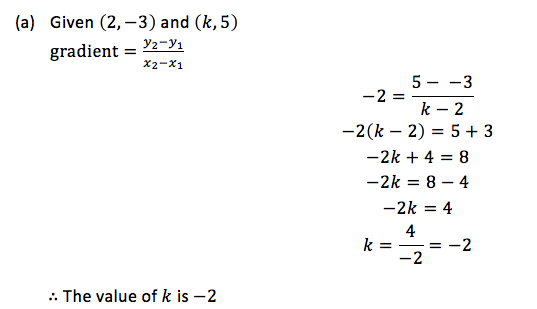
- The line joining (2,−3) and (𝑘, 5) has gradient −2. Find 𝑘
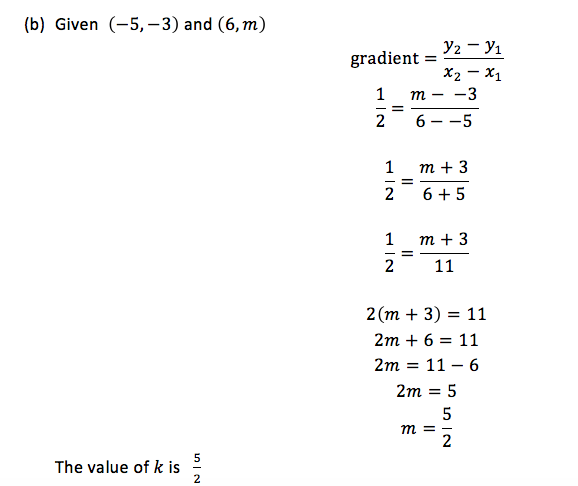
- Find the value of 𝑚 if the line joining the points (−5,−3) and (6,𝑚) has a slope of½
Solution
Coordinate Geometry
Mathematics Form 1
The Equations of a Line Given the Coordinates of Two Points on a Line
Find the equations of a line given the coordinates of two points on a line
The equation of a straight line can be determined if one of the following is given:-
- The gradient and the 𝑦 − intercept (at x = 0) or 𝑥 − intercept ( at y=0)
- The gradient and a point on the line
- Since only one point is given, then
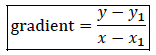
- Two points on the line
Example 3
Find the equation of the line with the following
- Gradient 2 and 𝑦 − intercept −4
- Gradient −2⁄3and passing through the point (2, 4)
- Passing through the points (3, 4) and (4, 5)
Solution
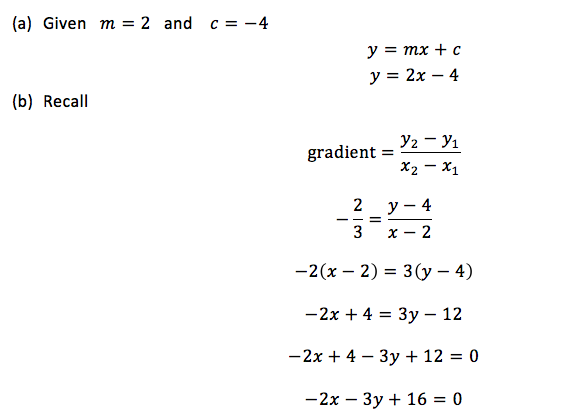
Divide by the negative sign, (−), throughout the equation
∴The equation of the line is 2? + 3? − 16 = 0
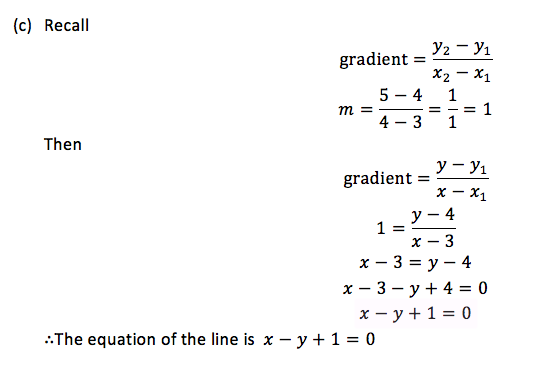
The equation of a line can be expressed in two forms
- 𝑎𝑥 + 𝑏𝑦 + 𝑐 = 0 and
- 𝑦 = 𝑚𝑥 + 𝑐
Consider the equation of the form ? = ?? + ?
? = Gradient of the line
Example 4
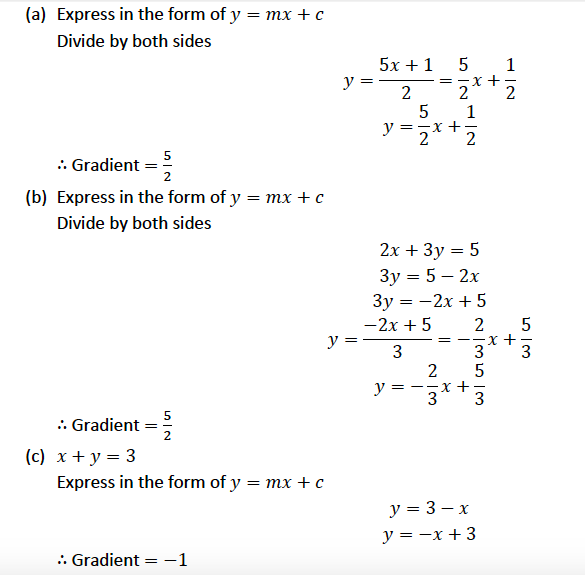
Find the gradient of the following lines
- 2𝑦 = 5𝑥 + 1
- 2𝑥 + 3𝑦 = 5
- 𝑥 + 𝑦 = 3
Solution
Intercepts
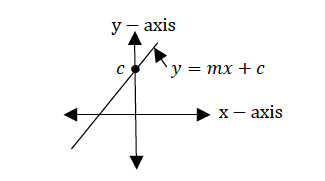
The line of the form ? = ?? + ?, crosses the ? − ???? when ? = 0 and also crosses ? − ???? when ? = 0
See the figure below
Therefore
- to get 𝑥 − intercept, let 𝑦 = 0 and
- to get 𝑦 − intercept, let 𝑥 = 0
From the line, ? = ?? + ?
? − intercept, let ? = 0
? = ? 0 + ? = 0 + ? = ?
? − intercept = c
Therefore, in the equation of the form ? = ?? + ?, ? is the gradient and ? is the ? − intercept
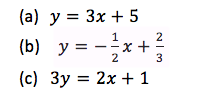
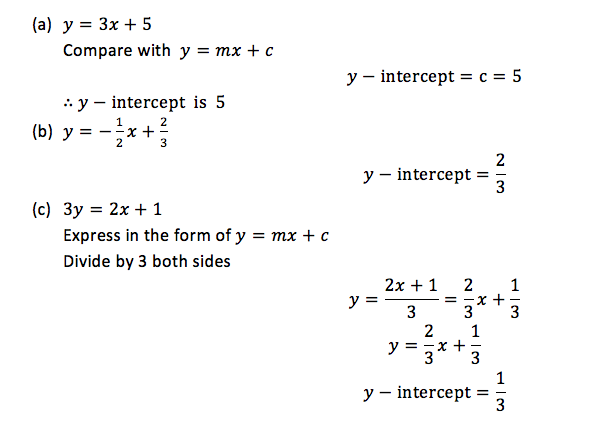
Example 5
Find the ? − intercepts of the following lines
Solution
The Table of Value
Form the table of value
The graph of a straight line can be drawn by using two methods:
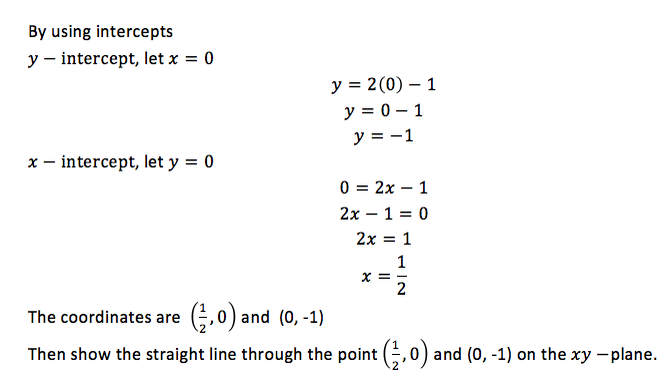
- By using intercepts
- By using the table of values
Example 6
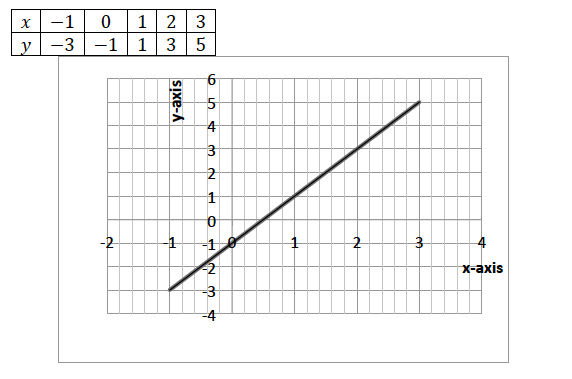
Sketch the graph of ? = 2? − 1
Solution
The Graph of a Linear Equation
Draw the graph of a linear equation
By using the table of values
Linear Simultaneous Equations Graphically
Solve linear simultaneous equations graphically
Use the intercepts to plot the straight lines of the simultaneous equations. The point where the two lines cross each other is the solution to the simultaneous equations
Example 7
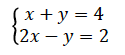
Solve the following simultaneous equations by graphical method
Solution
Consider: ? + ? = 4
If ? = 0, 0 + ? = 4 ? = 4
If ? = 0, ? + 0 = 4 ? = 4
Draw a straight line through the points 0, 4 and 4, 0 on the ?? − plane
Consider: 2? − ? = 2
If ? = 0, 0 − ? = 2 ? = −2
If ? = 0, 2? − 0 = 2 ? = 1
Draw a straight line through the points (0,−2) and (1, 0) on the ?? − plane
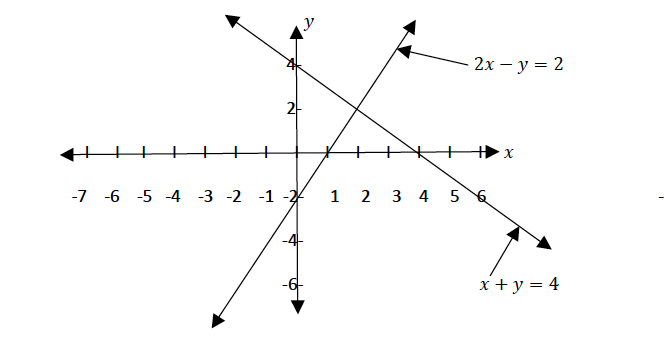
From the graph above the two lines meet at the point 2, 2 , therefore ? = 2 ??? ? = 2
Exercise 1
1. Find the gradient of a line joining the points M(-3,1) and N(4,7).
2. Find the equation of a line which passes through (1,2) and a gradient of -3.
3. Given that the line y=2x+c passes through the point A(1,3). Find the value of c.
4. Find the gradient of a line joining points A(-1,2) and B(3,-2).
5. A straight line of a gradient 5 passes through the point B(3,-8). Find the equation of the line.
6. Draw the graph of the equation y = 4x+1: use the graph to answer the following questions.(a) What is the gradient? (b) What is the value of the y- intercept? (c) What is the value of y when x = -1?
The Perimeters of Triangles and Quadrilaterals
Find the perimeters of triangles and quadrilaterals
Perimeter – is defined as the total length of a closed shape. It is obtained by adding the lengths of the sides inclosing the shape. Perimeter can be measured in ?? , ?? ,?? ,?,?? e. t. c
Examples
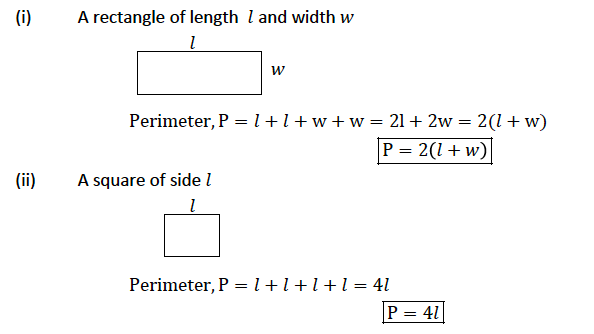
Example 1
Find the perimeters of the following shapes
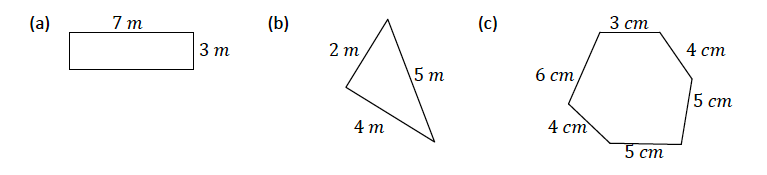
Solution
- Perimeter = 7𝑚 + 7𝑚 + 3𝑚 + 3𝑚 = 20 𝑚
- Perimeter = 2𝑚 + 4𝑚 + 5𝑚 = 11 𝑚
- Perimeter = 3𝑐𝑚 + 6𝑐𝑚 + 4𝑐𝑚 + 5𝑐𝑚 + 5 𝑐𝑚 + 4𝑐𝑚 = 27 𝑐𝑚
The Value of Pi ( Π)
Estimate the value of Pi ( Π)
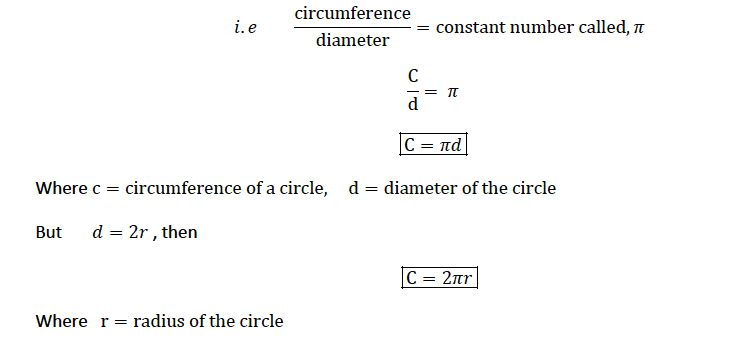
The number π is a mathematical constant, the ratio of a circle's circumference to its diameter, commonly approximated as 3.14159. It has been represented by the Greek letter "π" since the mid 18th century, though it is also sometimes spelled out as "pi" (/paɪ/).
The perimeter of a circle is the length of its circumference ?. ? ????????? = ?????????????. Experiments show that the ratio of the circumference to the diameter is the same for all circles
The Circumference of a Circle
Calculate the circumference of a circle
Example 2
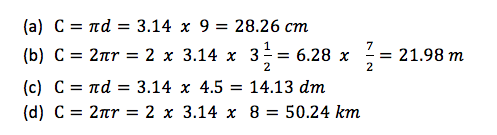
Find the circumferences of the circles with the following measurements. Take ? = 3.14
- diameter 9 𝑐𝑚
- radius 3½𝑚
- diameter 4.5 𝑑𝑚
- radius 8 𝑘𝑚
Solution
Example 3
The circumference of a car wheel is 150 ??. What is the radius of the wheel?
Solution
Given circumference, ? = 150 ??
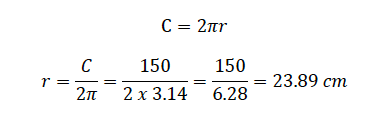
∴ The radius of the wheel is 23.89 ??
The Area of a Rectangle
Calculate the area of a rectangle
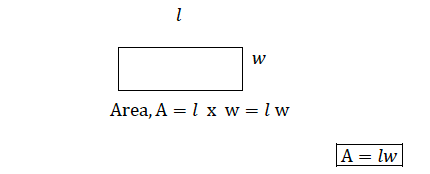
Area – can be defined as the total surface covered by a shape. The shape can be rectangle, square, trapezium e. t. c. Area is measured in mm!, cm!,dm!,m! e. t. c
Consider a rectangle of length ? and width ?
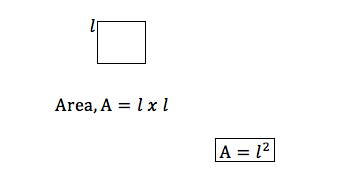
Consider a square of side ?
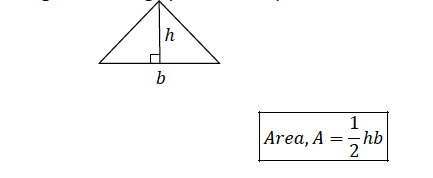
Consider a triangle with a height, ℎ and a base, ?
The Area of a Parallelogram
Calculate area of a parallelogram
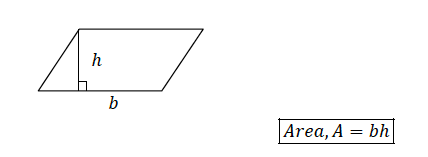
A parallelogram consists of two triangles inside. Consider the figure below:
The Area of a Trapezium
Calculate the area of a trapezium
Consider a trapezium of height, ℎ and parallel sides ? and ?
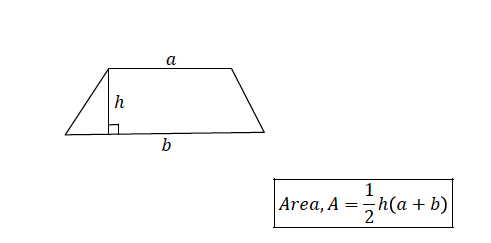
Example 4
The area of a trapezium is120 ?!. Its height is 10 ? and one of the parallel sides is 4 ?. What is the other parallel side?
Solution
Given area, ? = 120 ?2, height, ℎ = 10 ?, one parallel side, ? = 4 ?. Let other parallel side be, ?
Then
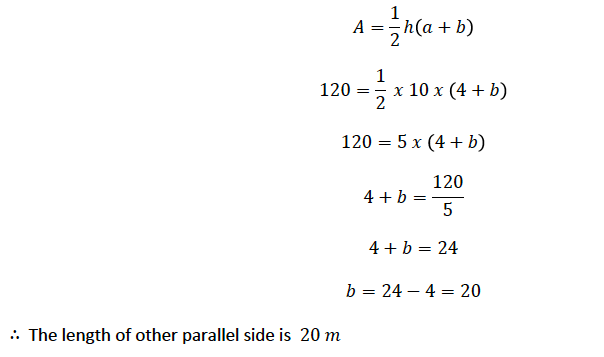
Areas of Circle
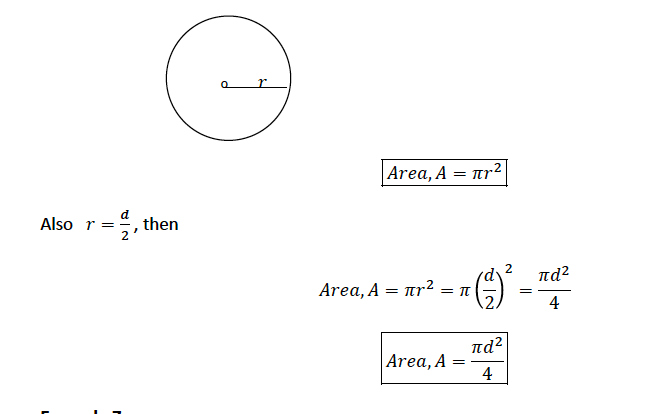
Calculate areas of circle
Consider a circle of radius r;
Example 5
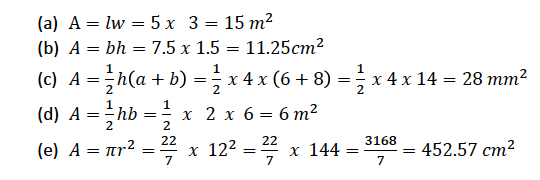
Find the areas of the following figures
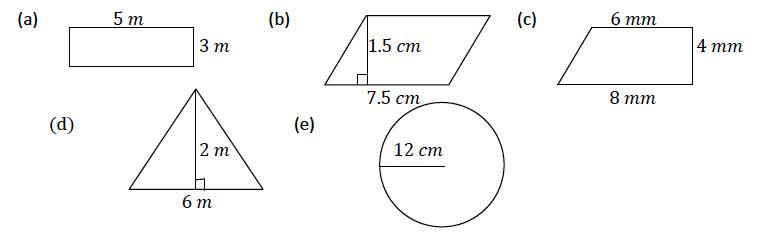
Solution
Example 6
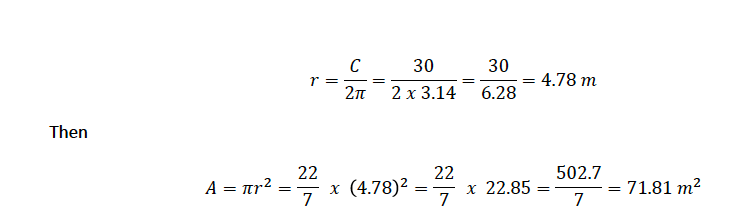
A circle has a circumference of 30 ?. What is its area?
Solution
Given circumference, ? = 30 ?
C = 2??
Exercise 1
1. The length of a rectangle is 6 cm, and the width is 4 cm. Find the perimeter and area of a rectangle.
2. Find the area of a circle with diameter 35 cm.( use Π = 22/7)
3. Calculate the area of a trapezium with parallel sides 3 cm and 5 cm and distance between them is 12 cm.
4. Find the height of a triangle with base 50 cm and area 300 cm2.
5. Find the area of a circle of diameter 40 cm. ( given π=3.14).