ENGLISH FORM 1
 Study Notes
 Discuss
 Bookmarks
Questions on Simple Oral Texts on Events
Questions on Simple Oral Texts on Events
SPORTS DAY
It was Sports Day at our school so students gathered at the playground which was full of students from different schools within the Morogoro region. At 4pm, a match between Kilakala Secondary School and Bigwa Secondary School, a sister school began. The referee called all players to line up at the centre of the football pitch and the coaches directed their teams to the centre of the football pitch. Spectators gathered and cheered at their teams. One of players, Siha, injured another player, Janet, on her leg. Janet was given first aid and treated for her injuries.
When the match approached the to end, two students ran into each other, and one of them, Jane, fainted. Five minutes before the end of the match, the Kilakala football team scored a goal, declaring them the winners. The referee blew his whistle and the team members left the football pitch.
Exercise 1
Give the meaning of the following words as used in the story:
- Competitor
- Crash
- Spectator
- Referee
- Football pitch
- Coach
Questions on Simple Oral Texts on a Variety of Situations
Question on simple oral texts on a variety of situations
OUR SCHOOL
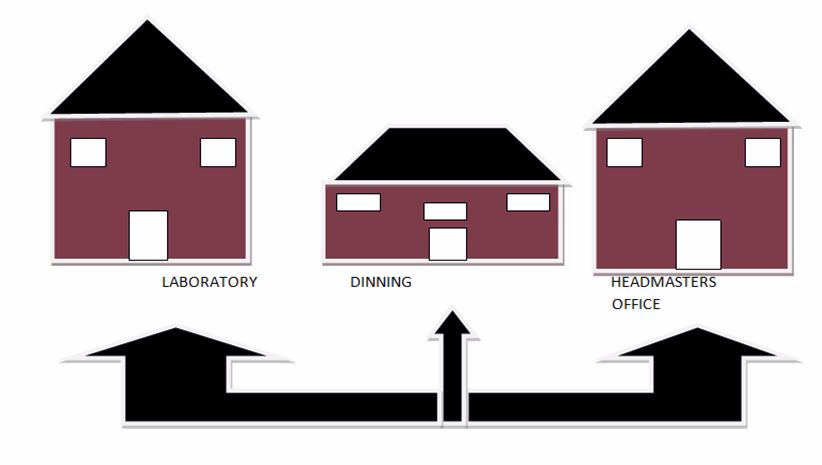
The school Head Master’s office is next to the laboratory which students use to conduct different experiments in biology, chemistry and physics. At 2 pm, students go to the assembly hall for daily announcements on routines and activities. The dining hall is between the school lab and the dormitory; students eat their meals in the dinning hall. There are many fruit vendors near the dining hall selling apples, pineapples, oranges, and bananas. After their meal at 5 pm, students go to their dormitories to shower and clean up. There are several bathrooms and laundry rooms where the students take baths and wash their clothes. After their evening meals, students normally go to the classrooms for personal study.
Writing Down What is Read
Write Down What is Read
Dictation is the act or process of saying or reading words which are written down by another person. It can take place in school seminars or certain training sessions.
Activity 1
Write down the text as read by the teacher
A terrible accident occurred last Sunday along Morogoro Road; a lorry hit a pedestrian crossing the road at the Msamvu junction. The pedestrian died on the spot. The police arrived at the scene of the accident and called an ambulance from Morogoro Regional Hospital. The body was taken to the hospital's mortuary before being collected by relatives and buried at Kola Hill.
Activity 2
Write down the words below as read by a teacher
- Pencil
- Exercise
- Survival
- Environment
- Dormitory
- Desk

Giving Directions
English Form 1
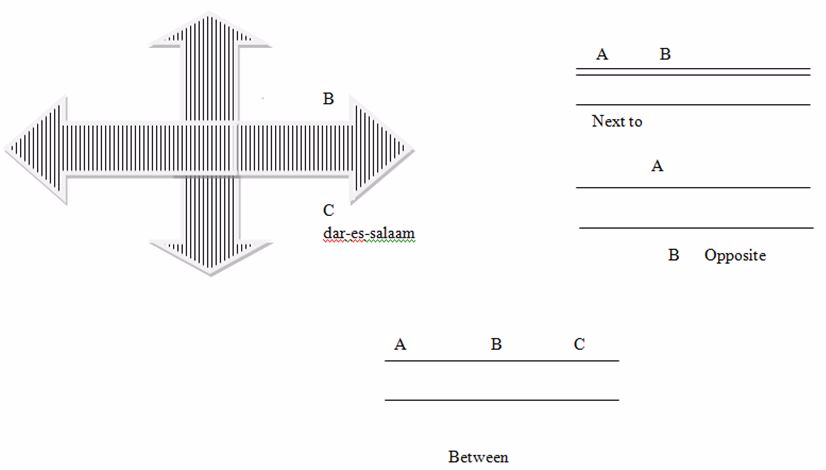
This requires students to have knowledge of how to ask for directions and identify the four points of a compass; using various prepositions such as: near to, in front of, beside, behind, under, adjacentto,between, on, in, to, by, at, into, onto, etc. for different situations.
Giving and Asking for Directions
Give and ask for directions
Activity 1
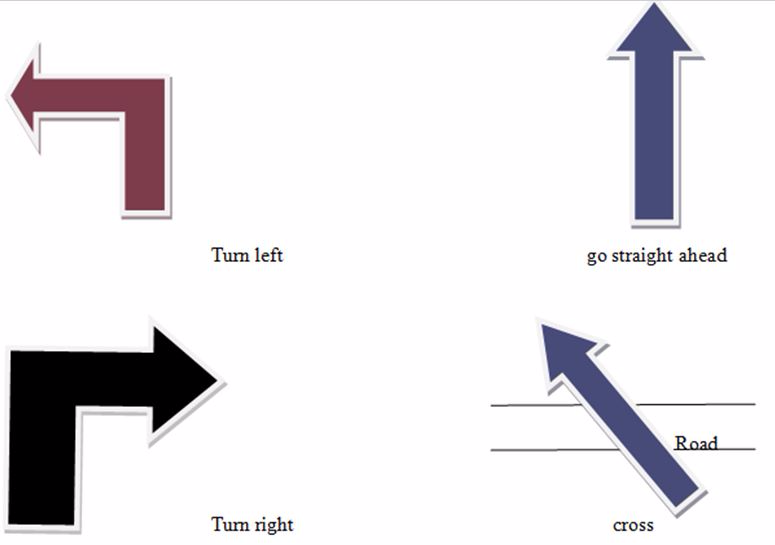
Learning words and expressions related to the directions below:
Activity 2
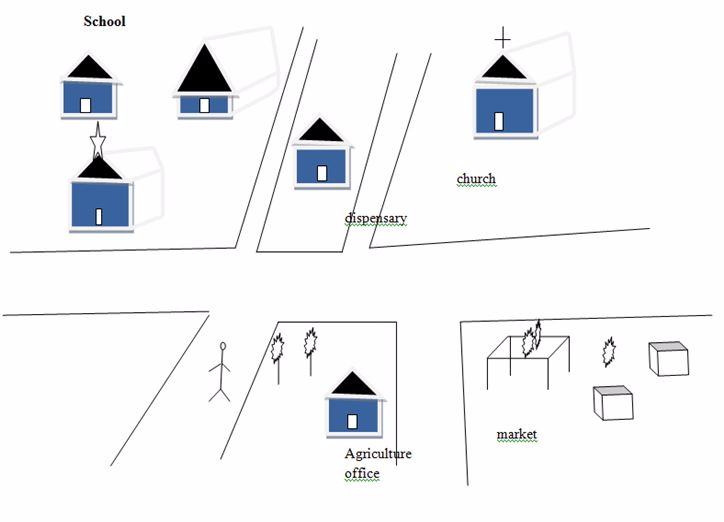
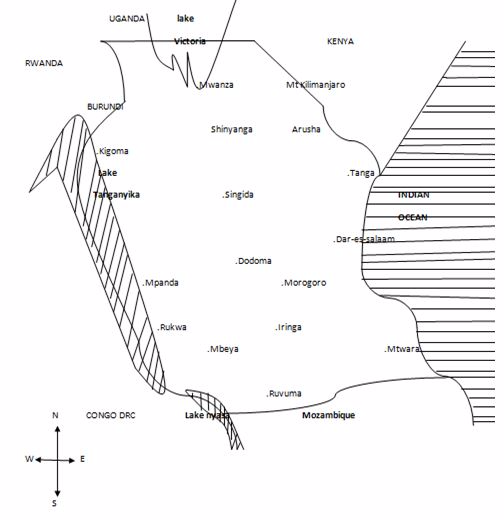
Look at the map below and imagine you are one of the children asking for directions. Practise asking for and giving directions to:
- The mosque
- The dispensary
- The market
- The school
Words used when giving directions:
- Go straight
- Cross bridge
- Turn left
- Keep straight
- Turn right
- You will see
- Cross junction
- Walk along
Important issues when giving directions
- Use basic English to offer directions.
- Short phrases are best.
- Speak slowly.
- Use clear pronunciation.
- Spell out words if necessary.
In giving directions:
- Use transitions: After that, then, next, when you get to……… go
- Specify distance: Some people feel better knowing how long it will take to get to their destination, example "it’s about five minutes away."
- Use landmarks:"You will see large clock", "You will see blue large building."
- More useful language: It’s on [street name], It's opposite ...., It’s near .....
- Repeat yourself: If you repeat the direction again, the other person will feel comfortable.
- Clarify:Make sure that the person understands your directions, example "did you get all that?"
- Don’t guess: I am sorry, I'm not from here, I'm afraid I can’t help you."
Four Points of the Compass
Show four points of the compass
The Compass
Talking about One's Home Routines/Habits
Talk about his/her home routine/habits
My name is Gabriel. I’m a 12 year old Tanzanian living in Bunda town. I wake up early, at about 6 am, then I brush my teeth and take a bath before quickly having some breakfast.
I usually have tea with chapati before riding my bicycle to school at 8 am. I go straight to the assembly ground to hear the morning speech, news and announcements from teachers. After this I go into class before break time at 11am. The school day finishes at 2pm. When I reach home, I have my lunch and rest at 4 until 6. At 7:30, I have my supper before revising my school work. Then at 10 pm, I wish my mother and my father a goodnight before going to sleep.
Activity 1
Write a short description of any of the following:
- How you prepare for school each day?
- What you do over the weekend?
- What you do on public holidays?
My daily routine
My name is Julie and I live in Ilemela with my aunt. I work as an assistant manager at an electric power company. I normally wake up at 6 am, brush my teeth and take a bath quickly before having tea and vitumbua. Then I go to work, have lunch around noon and continue with work. At 4 pm, I leave work and head back home. When I reach home, I usually find my aunt busy watering the garden. I greet her, have a little rest until 6 when I prepare dinner. We eat at 7:30 and watch some news before going to sleep at 10pm.
Exercise 1
Answer the following questions according to the text above:
- What time does Julie wake up?
- Who does Julie stay with?
- What does Julie works as?
- What time does Julie have lunch?
Talking about Activities being done by Oneself and/or other Creatures/Things
Talk about Activities being done by Oneself and other Creatures/Things
Example 1
Examples of ongoing activities
- I am teaching computers.
- My mother is watering the garden.
- She was cooking Ugali.
- The sun is shining the whole day.
- Are you travelling to Accra?
- The bell will ring at 4:30am.
Activity 1
Read this conversation and then answer the questions that follow:
Masu : Hi, how are you?
Mosi: Very well, thanks!
Masu: Can I see what you’re doing?
Mosi : Certainly!
Masu : Great, my name is Masu.
Mosi : My name is Mosi. The boy riding a bike is my young brother, Linus.
Masu: Is he learning how to ride?
Mosi: No, he is already a good rider, I coached him. He is competing in bicycle competitions in the next month.
Masu: I see, but what are you doing with that small clock?
Mosi: It is not a clock, it’s a stopwatch. I am timing how long he takes to ride one lap. Just watch as he finishes a lap. Linus, 28 sec? You’re slowing down, speed up!
Linus: I am getting tired sis!
Mosi: Try to ride faster for 24 seconds on the next lap!
Masu: I can see you are pushing him hard.
Mosi: Yes, this is the only way to train him. He has to go for the zonal race; 'no pain no gain' remember?
Masu: I also have a bicycle I like riding, but I don’t think I can train to compete.
Mosi: Well, we are not always just training. We also play here at Mrembeni Children Park. Would you care to join us?
Masu: Thanks, that would be great! I am new in town and so I don’t have many friends yet.
Questions
Write "true" if the statement is true and "false" if the statement is not true for each of the following statements:
- Linus is riding a bicycle……….
- Mosi is teaching her brother how to ride a bicycle…………
- Linus is preparing to ride in a cycling competition………..
- Mosi is good coach…………
- Mosi is punishing Linus because she is a cruel sister……….
- Linus is riding slower because he is tired…………
- Masu doesn’t like cycling…………..
Expressing Likes And Dislikes
English Form 1
Talking about Preferences
Talk about preferences
Read the following story.
My name is John and I like bananas and avocados. My friend Asha prefers drinking tea to coffee. My bother, Amabilis prefers travelling to staying at home all year. I prefer living in town to living in the village because we have access to more services in town.
Exercise 1
- What does John's prefer to eat?
- What does John’s older brother prefer?
- Where does John prefer to live?
Expressing Kinship
Express kinship
My name is Birungi; my mother’s name is Makrita and my father’s name is Juma. My uncle from my mother's side is called John and another uncle on my father’s side is called Jamal. My grandfather lives in Ihanga village with his three sons; Bahari, Jamali and Bakari. I have five brothers; Atanas, Mussa, Geoffrey, David and Chris. My uncle has two sisters, who each have two children. Chris’ father in law is called Matata and Jamal’s sister in law is called Asnat. Bakari’s cousin is called Matata and Matata’s nephew is called Jamila. David’s niece is called Musa. His sister in law lives in Mahenge village.
Example 1
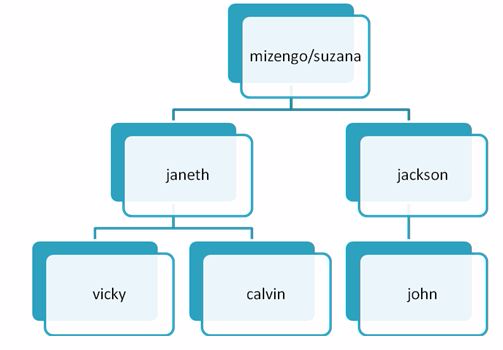
Example of family tree diagram representing Mizengo and Suzanna's family
Expressing your Opinions
Express his/her opinions
Read the following text about Corporal Punishment
School Corporal Punishment refers to the physical punishment of students. I think corporal punishment is bad for the following reasons: Firstly, corporal punishment creates enmity between the teacher and students which can cause students to perform badly. Secondly, this kind of punishment can lead to severe injuries to students. Thirdly, it also creates fear among students. My advice is that corporal punishment should be prohibited, students should be advised and counselled instead.
Exercise 1
- Mention the effect(s) of corporal punishment.
- Give your opinions about the following; (a) the Environment. (b) HIV/AIDS (b) School rules (c) Child labour.
Expressing Opinions And Feelings
English Form 1
Narrating One's Character
Narrate his/her activities
We closed school for the holidays and I was both excited and nervous. I was anxious to see my father and mother so I called my mother to tell her that I would be leaving for home Friday morning. The journey home went well and I saw beautiful landscapes like Mount Usambara. We arrived in Arusha City at 4:30 pm and found my father and young brother waiting for me at the bus station. I was very happy to see them! Once home, I did many activities such as going to shamba, washing dishes, watering the garden and visiting my friends. I really enjoyed my holiday!
Narrating Past Events
Narrate past events
An event is an action/activity that happened, is happening or is going to happen. Some actions are planned and others are unplanned/unexpected. In 1929-33 there was a great economic depression which started in the U.S.A and spread all across the world. These events can be counted in terms of days, hours, weeks, months, years and etc. and can be recorded onto magazines, gazettes, video tapes, etc. There are different words used when talking about past events. These are words such as; "last [week, month, year]," "yesterday". In addition, the verb ’be’ turns into ; was and were. For instance, ’last week I was playing football.’
Activity 1
Write a short passage about your past events in not more than one page.
This refers to reading detailed information for comprehension. We can read intensively about diseases, soil erosion, drug abuse, and child labour.
Responding to Specific Questions on Text Read
Respond to specific questions on a text read
Read the following text and answer the questions that follow:
MALARIA THE KILLER DISEASE
Malaria affects people, apes, monkeys, and other mammals. It is one of the most ancient diseases known to man. In America, the first cases of the disease were reported in 1493 - hence the belief that it was probably imported by Columbus and his expedition.
The main transmitter of the disease is the female anopheles mosquito, however,one can acquire malaria through artificial means, such as blood transfusion. When one is bitten by the anopheles mosquito, the blood is infected by a germ called plasmodium. A person who has contracted malaria will suffer from symptoms including periodic fever, spleen enlargement, loss of appetite, vomiting, headache, and anemia. There is a general belief that there is only one type of malaria, this is false. As you can see below, there are several types. The most widespread variety is the Vivax malaria, sometimes called Tertian malaria. This type is notorious for resisting treatment. There is also falciparum malaria, also called Subtertian malaria. This has the most severe and most fatal. It develops best in areas with high temperatures hence its confinement to tropical areas. There is also Quartian malaria, prevailing in the Mediterranean coast land. Tertian malaria has been reported in East Africa and isolated areas of South America.
Now that malaria is killing thousands of people each day, are we all going to perish? The answer to this question is yes; unless deliberate efforts are taken to prevent it. There are preventive measures against this killer disease, these include destruction of the mosquito breeding places, taking anti-malaria drugs and using treated mosquito nets. If you think you have malaria, you have to consult a qualified physician for proper diagnosis and medication. For varying reasons, some people opt for local herbs.
Exercise 1
- Mention four preventive measures against malaria, other than those given by the author in the passage above.
- Describe the relationship between mosquito, plasmodium, and malaria
- Are majority of Tanzanians aware of the malaria disease? (give five reasons).
- Define the following terms that have been used in the passage a) infection, b) diagnosis, c) germs, d) prescription, e) symptoms, f) physician
The Message from Simple Stories Read
Explain the message from simple stories read
This story is about a man called Masumbuko, his neighbour and a rope. Masumbuko was friendly to most of his neighbours but there was one woman who he didn’t like. She was very interested in other people’s business and liked to gossip. It was a habit of hers to borrow things from her neighbours and forget to return them. This woman knew Masumbuko had a new rope in his shed and one day she came to his door and asked to borrow it. 'Well,' said Masumbuko, ‘I need to know why you want my rope.' 'I did a lot of washing this morning and my clothing line broke,' she replied. Masumbuko did not believe the woman but lent her his rope anyway. It was custom to get along with one's neighbours. The woman did not return the rope until a week later and this annoyed Masumbuko very much. Several days later, the woman came to Masumbuko's door and asked to borrow the rope again.
'Well', said Masumbuko, 'what do you need a rope for this time?' 'One of my neighbours is cutting a big branch in my garden', she answered’. 'He needs a rope to pull the branch away from the roof of my house'. Doesn't he have a rope of his own?' asked Masumbuko. 'No, he doesn’t,' the woman answered rudely, ‘why do you think I am here asking for your rope if my neighbour has his own?' Masumbuko said nothing to the woman but went into his house. The woman could hear Masumbuko talking to his wife. A moment later, returned to the door. 'I am sorry,'he said to the woman,'but I can not lend you my rope right now; my wife is spreading flour on it.' 'She is spreading flour on it!' the woman exclaimed, 'but how can one spread flour on a rope? Are you trying to make me look like a fool?' 'Certainly,' Masumbuko answered, 'it is quite easy to spread flour on my rope when I do not wish to lend it to somebody.'
Exercise 1
Write short answers to these questions
- Who is main character in the story?
- Was Masumbuko friendly with his entire neighbourhood?
- What did the woman want from Masunbuko?
- What did Masumbuko say his wife was doing with the rope?
Questions on a Poem Read
Answer questions on a poem read
A poem is a piece of writing which consists of verses which form a stanza. A poet is a person who writes or composes a poem. A persona is a person who is speaking in the poem.
Read this poem and answer the questions by choosing the best alternative.
ALEX THE DRIVER
Alex the driver at the wheel
Bare his foot from toe to heel
Alex the driver big and fat
With a mourn round face and Muslim’s hat.
Alex the driver with a big white grin;
See how he crushes the gear in.
Alex the driver in his car
Bumps over dirt, stone and tar
Alex the driver at the wheel
With moon round face and a Muslim’s hat
Exercise 2
- What is the poem about? a) Alex the driver b) Conductor c) A boy d) Life
- The poet says Alex is a mechanical king, why does he say this?a)He drives slowly b) Because Alex knows how to handle his car well c) He drives fast. d) He likes money.
- The rhyming pairs in this poem are such as…….a) Wheel…heel, Fat …hat, Grin…in b) Drive, drove c) Sits, sets d) Fast, faster
- The poet likes to repeat some words and even a verse. Why does he do this? a) The words are simple b) It is good to repeat the words c) Simple to repeat. (d) So as to put emphasis on the recommended message.
Analysing Information From The Media
English Form 1
Non-Factual Information from Media
Identify non-factual information from media
Non-factual information refers to information which is not true, lacks an element of truth, and cannot be proved beyond doubt. It contains some elements of uncertainty.
Activity 2
Read the texts below and answer the questions that follow:
I think Tanzania's forests are in trouble. It is possible that Tanzania could lose its entire forest cover in under a century if more is not done to reduce the current rate of deforestation, estimated at round one million acres each year. There is a possibility that Mt. Kilimanjaro itself is severely affected by environmental damage. Perhaps, for thousands of years, the Serengeti winds would sweep over the cool and humid forest air carrying this moisture to the top of the mountain, but this is occurring at a smaller scale due to environmental changes.
It might be the deforestation on the slopes of mountain Kilimanjaro has contributed to the melting of its glaciers causing the East African trade winds to stay dry and warm accelerating the demise of the snow caps as this air flow reaches the summit. The dry winds also is no longer replenishing the glaciers, therefore, aiding in the demise of these magnificent mountains of ice. According to UN, Tanzanians population probably may be growing by over 2 percentages per year. It is possible to increasing rate of deforestation due to the demand of charcoal as a cheap source of energy. In addition burning down and cleaning of forests for crop cultivation in order to cater for this growth.
Exercise 1
- Analyse the non factual information from the text above.
- Identify five indicators of non factual information from the text above.
- Give the meaning of the following words as used in the passage: a) Ice, d) Fauna, b) Snow, e) deforestation, c) Flora, f) land degradation
- State whether the statement below is fact or non fact, according to the passage above. a) Tanzania's flora and fauna may lose its habitat because of deforestation. b) Tanzania’s population is growing by over 2 percent according to UN, c) There is a possibility of melting of glaciers due to the dry winds in the slopes of Mt. Kilimanjaro. d) The snow and glaciers from Serengeti go up onto Mt. Kilimanjaro summit.
Activity 3
Listen carefully to the newspaper text on gender read by your teacher and point out five facts and five non facts orally and in writing.
Personal Letters
Write personal letters
Friendly or personal letters are means of communication through letter. We normally write letters to loved ones, including mothers, fathers, uncles, aunts, sisters, brothers, lovers, wives, husbands, teachers, friends, etc.
We normally use statements such as 'Dear mother', 'Dear father','Dear sister','Dear friend', 'hi daddy',' hi mummy', 'hi aunt'. in the greeting (introduction part). We use expressions such as 'your loving daughter','your loving son', 'your loving………', 'missing you….....'in the closing remarks.
Components of a friendly letter
- Writer’s address -written on top right hand corner.
- Date - below the sender address.
- Salutation - comes after the address.
- Main body-states the aim or purpose of the letter.
- Closing statement-ending the letter.
- Signature and name of the writer/sender- extreme end of the letter.
Example 1
SAMPLE LATTER
Kongani Secondary School,
P. O. Box 340,
Pemba
05thDecember, 2014
Dearest Mother,
It is my hope that you are doing well. It's been a long time since I last wrote to you. I am generally fine and continue with my studies. By the way, we will close school for a short holiday this Saturday till early April. I ask that you send me some money for a bus fare from school.Please send me the money very soon so that I may pay the transport officers. Greetings to brothers Jorum and Maven and sisters Jacky and Joan, as well as all my friends.
I hope to see you during holiday and pray for you with best wishes.
Your loving daughter,
N.S
Nasra Shomari Mohamed.
Activity 1
Pretend that you are Nasra's mother and reply to the letter, informing her that you will send her some money before school closes.
This is the process of taking notes, either from spoken or written text. For example, from radio, television broadcasting and different stories or speeches or in the papers.
Important Points from Oral Texts
Write down important points from oral texts
What to consider when taking notes from different sources.
These include:
- To note down important information.
- Write in short phrases, not long sentences.
- To use dashes and other marks to separate points. These marks are used to separate the noted points to avoid mingling and/or redundancies.
Activity 1
Listen carefully from the text and take notes.
Early marriage puts girls at great risk. Due to their young age, they are not physically mature enough to become mothers. Early marriage also results in early and frequent childbirth, leading to large families. Forced early marriage also denies girls the right to enjoy their childhood, the right to education and the right to choose a husband they love and of their own age group. When girls are forced to marriage with older men, they are likely to become widows at an early age. When this happens, the young widows are left to take care of the children themselves or have to remarry. Many of these women struggle because African customs and traditions do not allow a young wife to inherit her husband's property as most customs deny women the right to own property.
Exercise 1
Write down the important points from the passage read to you.
Taking Notes
English Form 1
This is the process of taking notes, either from spoken or written text. For example, from radio, television broadcasting and different stories or speeches or in the papers.
Important Points from Written Texts
Write down important points from written texts
Kino jumped forward as the rifle fired and his large knife swung and cut through the man’s neck and chest. Kino was a terrible killer now. He took the rifle with one hand and with the other he pulled his knife out of the man’s body. Kino moved very fast. He turned around and hit a second man’s head. The third man crawled away into the pool. He then began to climb up the rocks where the water was coming down from. The man’s head and feet were caught in bushes. He cried and tried to climb up but Kino had become hard and cruel. Kino raised his rifle and fired, then saw the man falling backward into the pool. Kino walked into the water; in the moonlight he could see the man’s frightened eyes. Then Kino fired the rifle between the man’s eyes.
Kino stood and looked up to the cave, something was wrong. The insects were silent now. Kino listened and heard a sound. He knew the long, rising cry from the little cave on the side of the mountain. It was Juana’s voice. The sound was the cry of death.
Exercise 2
Write notes from the passage above.
Fill in the Varieties of Forms
Fill in the Varieties of forms
Activity 1
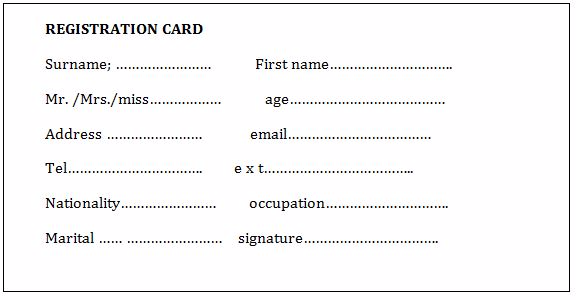
Imagine you are filling in this registration card for your friend. What questions would you ask him or her to fill it in?
Activity 2
Complete this visitor’s card.
| Name of visitor: |
| Address: |
| Arrival date: |
| Destination: |
| Flight no……………………………… |
| Flight arrival time…………………… Writing Things/Notes in a Diary Write things/notes in a diary Diaries or journals are books where you write what has happen each day, year, month, week, etc. It is written to help the writer to remember important events and thoughts. In their diaries, writers comment on what they have seen recently or previously. They also describe their thoughts and feelings. They record the reasons for doing or liking certain things. The language used in diaries is usually informal and the writer will often emphasise certain events and feelings that mean a lot to them. A calendar diary has printed dates, months, days and sometimes years. This helps the writer not have to write them over again but only write when there are details; they are mostly used for work. In it, people record appointments, reminders, meetings, and plans for each day in the future. A diary is a book with pages for each day of the year in which you can write down what you do each day and what you plan on doing in the future. A dairy can also be used to write our private thoughts and feelings, views or opinions. Sample of a Diary  |